
What makes a good winter fishery? Is it big fish? A non-pressured location? Species variety? Lots of photos and video on social media?
Well, it’s probably a combination of all of the above these days as our fishing community is certainly connected and monitoring the online realm where photos of “dirty 30” limits draw hundreds of clicks and inspire anglers to visit new (or rejuvenated old) waters.
Recently, with the addition of live sonar fishing tactics many waters have produced impressive limits by anglers often fishing where no one tread before – open water around baitfish. There’s no judgement here, only information on where to go this winter to find the best fisheries in Virginia.
Lake Anna
Let’s start with the lake that has made some headlines with more 30-pound tournament limits than any other in the state. Anna, at around 13,900 acres (@9,500 public) is not a very large lake but thanks to the stocking of F1/N1 hybrid largemouth bass and the use of live sonar, has been attracting some attention.
The lake harbors good numbers of five- to seven-pound bass and more and more eight pounders from the tiger bass stockings. Hydrilla and water willow grass has spread in the lake improving habitat both along the shoreline and offshore. A forage base of threadfin shad, gizzard shad, blueback herring, bluegill and white perch as well as crawdads supercharged the tiger bass growth rates.
Combine that with more and more anglers adept at using live sonar and you have recipe for some big five fish limits that can average over five pounds per bass.
Wil Vickery of Anna’s Marine Center and his partner Hunter Iden produced a 30-pound limit in December fishing the Sturgeon Creek Marina Winter Series tournament. Vickery noted they were using Garmin LiveScope to identify and track the fish they were targeting. This was not the first time they had a massive Anna limit. Fishing in the same series in 2024-2025 they also had a 30-pound limit. Other anglers in the series have weighed a number of 25-pound plus limits this winter.
Guide C.C. McCotter, who has carried clients out on Anna for the past 32 years notes that even anglers not familiar with forward facing sonar fishing can expect a 20-pound plus limit on many winter days fishing Anna.
“While many of these big winter limits are caught on jig and minnow, anglers also catch their share on suspending jerkbaits, swimbaits and Alabama rigs,” he says, “Winter fishing Anna has become very popular for anglers seeking big bass.”
Anna is also home to striper, wiper, crappie and saugeye and each bite well during the colder months.
“We have something called a Grand Slam which is catching a bass, striper, wiper and crappie in one day. I’ve had a number of clients achieve this. We are now trying for the Super Slam which includes a saugeye. No one has accomplished that yet,” McCotter notes.
The lake is also a strong contender to produce the next state record saugeye with two six pounders caught by McCotter’s clients last season. The state record is 6-8 from Lake Gaston.
Smith Mountain Lake
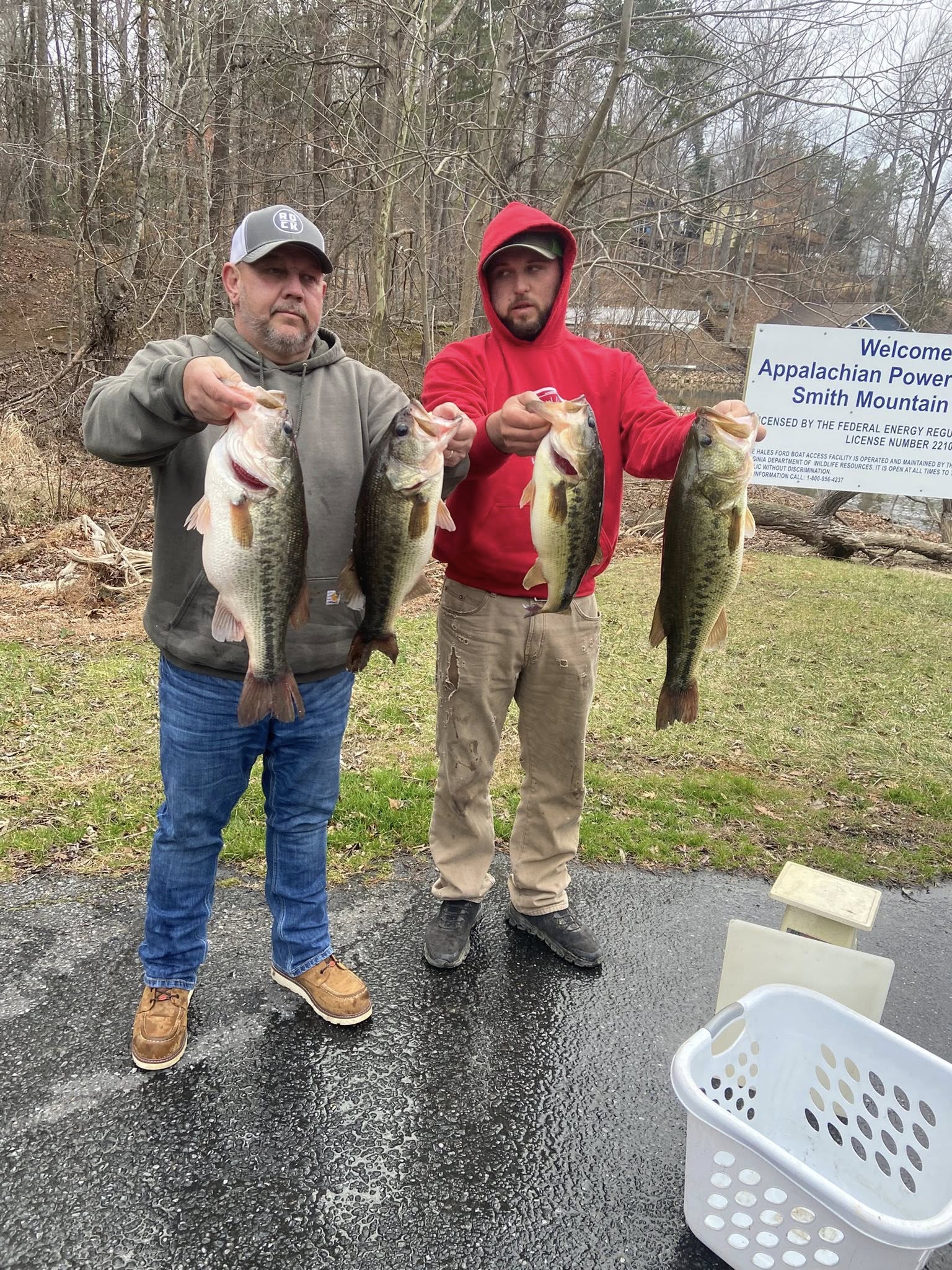
This 20,600-acre highland reservoir near Roanoke always had decent bass fishing but over the past six years anglers have noticed a considerable increase in size and tournament limits are increasing. Much of this can be attributed to a stocking of F1/N1 largemouth bass initiated by local anglers. The reservoir is owned by American Electric Power Company and is managed primarily for hydroelectric power generation. Most of the shoreline is developed with residential.
Largemouth and smallmouth bass are the most sought-after species by anglers at Smith Mountain Lake. Largemouth bass comprise approximately 90% of the black bass fishery. Extensive electrofishing surveys conducted by DWR fisheries biologists each spring provide annual assessments of the population and indicates the largemouth bass population is currently at the highest levels ever recorded in DWR samples.
The bass population at Smith Mountain Lake is very good but this fishery receives a lot of fishing pressure, making it challenging for many anglers. The lake has good largemouth bass numbers throughout the reservoir but the highest densities of them in this reservoir are found upstream (heading away from the dam) of Hales Ford Bridge area in the Roanoke River arm and buoy B26 in the Blackwater River arm. However, anglers are often more successful in the downstream areas where the water is less stained and bottom contours are flatter than the more vertical shorelines of the upper end. Smallmouth bass are most abundant in the downstream end of the reservoir. Bass tend to move into deeper water, closer to the main channel areas, and often suspend seeking schooling shad during the coldest months (Jan-Feb).
The Department of Wildlife Resources is currently involved in a pilot program to assess the potential for enhancing the quality of largemouth bass fisheries in large Virginia reservoirs (1,000 acres and larger) by stocking F1 largemouth bass (also referred to as “Tiger” Bass) at relatively low rates.
F1 largemouth bass are produced by using one parent that is 100% Florida largemouth bass and the other 100% northern largemouth bass. Crossing these 100% parents often produces offspring that grow a little faster than wild largemouth bass. Interestingly, the wild largemouth bass in Smith Mountain Lake were actually about 50% Florida and 50% northern genetics before stocking began, so stocking will not change the genetic makeup of the current bass population.
Only the first cross of the 100% x 100% parents exhibit the growth advantage, so future offspring of the stocked bass will perform and grow just like the current wild bass.
Smith Mountain Lake received the first stocking in 2015 and DWR has recently added four additional large reservoirs as test waters for this project. Only the reservoirs included in this pilot program will be stocked with F1 largemouth bass until the success, or lack of, has been fully evaluated.
There are two primary components of the bass stocking study; how much do stocked bass add to the overall bass population and do stocked fish achieve larger sizes and improve the catch of trophy bass? Evaluation of the stocking program at Smith Mountain Lake to date, shows stocked bass have only increased the population by approximately 5%. Samples of largemouth bass weighing at least four pounds, have been collected each spring, since 2019, to evaluate the trophy component of the stockings. The first stocked bass weighing over four pounds was found in 2019. Stocked bass collected over four pounds continues to increase and added 13% to the number of bass collected over four pounds in 2021.
Winter tournament anglers regularly exceed 25 pounds with SML limits and eight-pound bass are not uncommon. The lake also harbors big smallmouth bass and striper which bite well during winter months, too.
Chickahominy Lake
Just northwest of Williamsburg you’ll find a 1,230-acre water supply reservoir located along the New Kent-Charles City county line. This impoundment of the Chickahominy River was completed in 1943 with the construction of a low-head dam known locally as Walkers Dam. A fish ladder constructed into the dam allows for the passage of anadromous fish such as blueback herring and striped bass.
This cypress-laden lake provides spectacular scenery and at times, excellent largemouth bass fishing. The cypress trees, water lilies and submerged aquatic vegetation (SAV) provide excellent habitat for aquatic organisms and are undoubtedly one of the reasons for the consistently good fishing at this lake over the years during warmer months.
Recently however, the live sonar trend has reached Chick Lake and anglers skilled with this tactic have been setting some impressive new marks for tournament limits approaching 30 pounds.
Fishing deep water in the lower end of the lake has proven productive for “scopers” using jig and minnow type baits and jerkbaits. Big glidebaits are also popular here in the late winter/early spring.
Lake Frederick
The challenge of fishing a small, clear highland reservoir for big bass awaits at this 117-acre impoundment owned by the Virginia Department of Wildlife Resources. The department acquired the lake and a 50-foot buffer around the entire shoreline in 1981. Lake Frederick remains clear throughout the year and stratifies forming a thermocline during the summer months. The lake has a maximum depth of 50 feet and an average depth of 20 feet. Much of the shoreline and the upper ends of the two embankments contain standing submerged timber. Typically, the standing timber is located along the shoreline out to around 25’ from the water’s edge.
Boat anglers are welcome. Only electric trolling motors are allowed.
The lake has an excellent population of largemouth bass, though they can be difficult to catch at times. DWR notes there are many fish in the two- to four-pound range in the lake. Lake Frederick has historically produced the best quality largemouth bass fishery in the Shenandoah Valley with anglers catching bass up to 10 pounds from the lake in recent years.
Angler Kris Allen recently landed a 9.98 largemouth fishing Frederick that helped him amass a 20-pound plus five fish limit.
Compared to bass from more southern latitudes, largemouth in Lake Frederick exhibit slow growth rates. It takes around six growing seasons for a bass to reach 14″ in Lake Frederick. The primary forage for largemouth bass are numerous small sunfish, black crappie, and blueback herring. The herring are a relatively recent and unwelcome addition to lake Frederick according to biologists. They were either introduced illegally or accidentally. They do provide a great forage fish for bass, but because of their pelagic nature, they draw a lot of bass away from the banks and out into the deeper basins of the lake. This makes it very difficult for bank anglers to target largemouth and boat anglers like Allen are using live sonar electronics to locate the fish.
Other fish species anglers might encounter while fishing Lake Frederick include: bluegill, redear sunfish, black crappie, channel catfish, and northern pike. VDWR annually stocks channel catfish, and northern pike. DWR did perform an experimental stocking of smallmouth bass in 2025.
Sandy River Reservoir
This a typical Piedmont fishery that harbors big bass and standing timber. Sandy River Reservoir is a 740-acre water supply impoundment located slightly east of the town of Farmville in Prince Edward County. It’s one of the newest lakes in Virginia with construction completed in 1994 and fishing opened in 1996. The reservoir was built and is owned by the county of Prince Edward with fisheries management responsibilities belonging to the Virginia Department of Wildlife Resources.
Two large areas of standing timber were left in the lake at construction to provide fish habitat structure. These areas are located at the upper end of Sandy River and the upper end of Marrowbone Creek.
This reservoir boasts some of the best sportfishing opportunities in the region. Anglers using live sonar have amassed limits over 30 pounds, especially fishing around the standing timber.
Hunter Smith enjoys fishing Sandy River Reservoir in the winter using his Garmin Livescope sonar. He notes there are some tricks to catching big bass on the central Virginia lake.
“In cold water situations on Sandy fishing around bait is king. Using Garmin forward facing sonar I like to find big bait balls and with that bait comes active feeding bass. I have found big bass cruise channel swing banks looking for bait. They use shallow water to pin schools of bait with quick access to deep water to push out,” he told W2.
He also noted his goal when locating bass on forward facing sonar is to find multiple fish together.
“Bass are very competitive and when I can get them to ‘compete’ over a lure it is almost a guaranteed bite.”
A final tip from the young gun: Smith says bass like to be around vertical structure in the winter. This can make for a difficult time when trying to line up a cast. He likes to try and pre-fish around the vertical structure to make sure he can make a cast that creates a lane for the fish to follow his lure without leading it straight into the vertical cover and an inevitable snag.
Smith’s go to baits for winter at Sandy River are the Bizz Baits Ring Roller jig head with a Bizz Baits Minner in the natural shad color, a Megabass 110 jerkbait and a Crush City Freeloader in Electric Shad.
Sandy River also supports excellent fisheries for black crappie, redear sunfish and channel catfish. Other species to note include bluegill and chain pickerel.
Upper James River
If weather conditions and flow rate permit, fishing the upper James River for smallmouth and musky can be outstanding in winter. W2 Pro Team member and guide Ken Trail says while there aren’t many tournaments held on the upper James there are plenty of five-pound plus brown bass and 40-inch muskie caught every winter.
“I would say January, February and early March is the best time to catch a truly trophy muskie from the upper James,” Trail told W2, “It’s pretty good for big smallmouth as well.”
Muskie are present in the upper James from Joshua Falls on up to the Iron Gate area (where the Cowpasture and Jackson meet to form the James). Particularly good stretches include the Glen Wilton to Eagle Rock section and from Eagle Rock on down to Horseshoe Bend.
Smallmouth bass are present throughout the upper James. The best fishing tends to be from Buchanan to Arcadia.