
Virginia wildlife officials are sounding the alarm that budget shortfalls could harm their ability to protect and manage the state’s wildlife, maintain popular fish stockings, prevent disease breakouts and manage conflicts between people and animals.
“We are not currently receiving the resources needed to uphold our responsibilities to Virginia’s fish and wildlife conservation legacy. While we have a long history of operating as a lean organization, things are starting to get difficult,” Virginia Department of Wildlife Resources Director Ryan J. Brown told Woods & Waters. “We have three budget amendments that Delegate Bloxom has been good enough to put in for consideration during this year’s General Assembly. These would help us tread water—they would increase our HB38 transfers by just enough to cover pending increases in the state budget; we’d still be in a shortfall situation overall, but it would be much less impactful and allow time for a more holistic solution to be developed.”
Brown and other DWR officials have shared their funding concerns to Virginia legislators during the 2026 General Assembly as well as worked to propose budget amendments that would bridge the funding gap temporarily so programs would not have to be dramatically reduced or even halted. Such programs could include the reduction or cessation of stocking of fish not produced by DWR including hybrid striper, F1 largemouth bass, channel catfish and trout. They have also begun informing the new Virginia Secretary of Natural and Historic Resources of the issue as he has come into office over the last several weeks.
DWR is charged with conserving and managing fish and game species in Virginia, including hunted species such as deer, bear, turkey and elk. The department also oversees regulations protecting all other wildlife species, wildlife regulation enforcement, habitat management and public hunting access.
Hunters and anglers pay for most of DWR’s work through hunting and fishing license purchases and federal excise taxes on firearms and other equipment. The Department also receives state sales taxes collected on outdoor equipment and watercraft, however large amounts of those funds are not completely transferred every year. Brown said that more complete funding of these revenue streams is the primary option for better funding the agency, without which increased license and registration revenues (and accompanying fees) would be a less desirable, but remaining option for reversing declining funding.
“Until Virginia has a broader conservation funding system where everyone who benefits from our shared legacy contributes, our work to benefit all wildlife will continue to fall on the backs of our hunters, anglers, and boaters, who have historically been the primary funders of this agency and of wildlife conservation overall here and in other states,” Brown said.
Virginia hunting and fishing license sales have declined as hunters age and fewer young people take up the sport. In recent year, inflation has spiked the costs of projects.
To better understand the funding dilemma, one needs to examine the current, flawed income streams that leave DWR dependent on sustainable revenue from several restricted sources. These include hunting and fishing licenses and permits, boat registrations and titles, federal funds (based on the number of hunting and fishing licenses and boat registrations issued each year), and just as importantly the transfer by the General Assembly of funds associated with the sales and use tax on watercraft as well as on hunting, fishing, and wildlife-watching equipment in the Commonwealth.
Together, these sales tax revenues, when transferred to DWR, make up more than 25 percent of the DWR’s annual budget. Although the Virginia Code directs these revenues to the agency, they are usually transferred at a reduced level each year, leaving DWR with insufficient funding. This situation is compounded by increased costs due to inflation, increased responsibilities that are not Federal grant eligible, and increased statewide expenses (e.g., employee raises, insurance rates, technology costs) which—when these increases come with no additional funding—require the DWR to divert resources from other programs and priorities.
In 1994, the Virginia General Assembly passed HB92, which provided that starting in the year 2000 and every year thereafter, the Department was to receive 100 percent of the Watercraft Sales and Use Tax collected by the Commonwealth (as authorized by §58.1-1402). Subsequently, the General Assembly passed HB2482 in 1997, which among other things, directed that all Watercraft Sales and Use Tax funds:
“shall be made available only to the Department of Wildlife Resources for the following: boating-related activities and expenses, and to enhance and improve recreation opportunities for boaters, including but not limited to, land acquisition, capital projects, maintenance, and facilities for boating access to the waters of the Commonwealth; boating safety law enforcement, including salaries, benefits, equipment and overtime expenses for game wardens so assigned; boating and other aquatic resource educational activities, including personnel, and education and safety materials; boating-related expenses for required reporting to federal and state officials; information management costs, including personnel, hardware, and software needed to better serve boating customers; and related administrative costs for boating-related activities, including human resources, accounting, public relations, administration and facilities to support and house necessary boating-related personnel and equipment.”
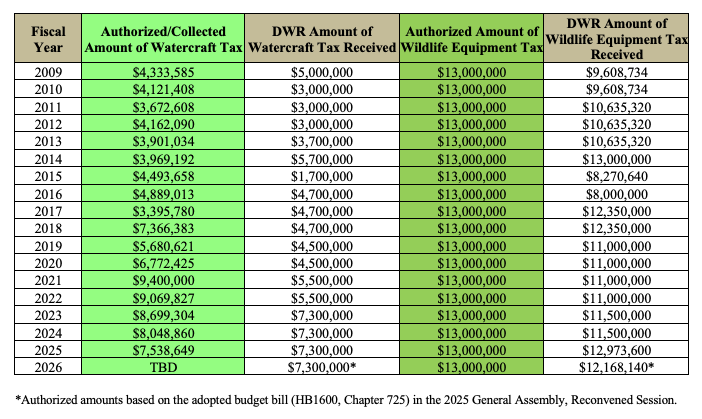
As these funds vary from year to year based upon watercraft sales, the annual Appropriations Act includes a projected transfer amount for the upcoming fiscal year, and then further authorizes the Governor to administratively direct the Comptroller to transfer any additional sums realized to the Department should collections exceed projections. That said, DWR has received these “excess” funds only three different times since 2009. Since 2017, this has resulted in a total of $16 million not reaching the agency as intended.
In 1998, the Virginia General Assembly passed HB 38, which authorized the “dedication and transfer of sales and use tax on hunting, fishing, and wildlife-watching equipment” to the Department of Wildlife Resources. Specifically, this act focused on the disposition of state sales and use tax revenue under § 58.1-638, and provided for the following:
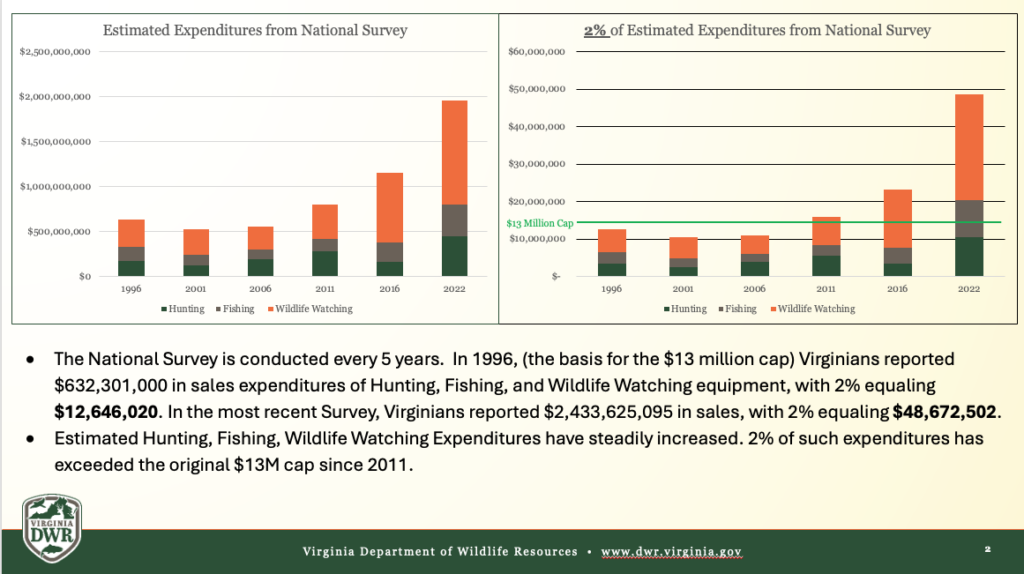
Beginning July 1, 2000, of the remaining sales and use tax revenue, the revenue generated by a two percent sales and use tax, up to an annual amount of $13 million, collected from the sales of hunting equipment, auxiliary hunting equipment, fishing equipment, auxiliary fishing equipment, wildlife-watching equipment, and auxiliary wildlife-watching equipment in Virginia, as estimated by the most recent U.S. Department of the Interior, Fish and Wildlife Service and U.S. Department of Commerce, Bureau of the Census National Survey of Fishing, Hunting, and Wildlife-Associated Recreation, shall be paid into the Game Protection Fund established under § 29.1-101 and shall be used, in part, to defray the cost of law enforcement.
DWR has received the full annual amount of $13 million only once in the past 16 years. While the annual “cap” of $13 million was based on the 1996 National Survey of Fishing, Hunting, and Wildlife-Associated Recreation—which estimated spending by hunters, anglers, and wildlife viewers to equal $12.6 million—this “cap” has not been increased since the original bill’s passage. The National Survey is conducted every five years, and on average, estimated spending by these same groups is closer to $19 million, and as high as $49 million from the latest survey in 2022.
Despite what is expected from the language associated with these two funding authorities, the Department has routinely received less than the total authorized and intended amount. This creates volatility within a critically important funding stream. The table with this article reflects past projections and receipts, and what’s anticipated for this year, for each fund.
The solution is simple: ensure full and consistent transfer amounts from these sources, both of which are tied directly to agency programs, that will allow the Department of Wildlife Resources to address mission critical priorities in wildlife and boating related management, education, enforcement, and recreational access opportunities. Demands on the agency continue to grow; costs continue to rise; and more recently agency services, which are expected by Virginia’s hunters, anglers, boaters, wildlife watchers and other outdoor enthusiasts, have begun to suffer.
In the lead-up to the 2026 General Assembly, DWR has proposed two Decision Packages that would enable more supportive and consistent transfer amounts for the agency: 1) Increase the original cap and annual transfer amount for the Sales and Use Tax on Hunting, Fishing, and Wildlife-watching Equipment (“House Bill 38”) from $13 million to $19 million; and 2) Strengthen the current provision for handling “excess” Sales and Use Tax on Watercraft to guarantee 100 percent of this tax revenue is transferred as intended. These two proposals, if adopted, would have transformed the agency’s abilities to enhance its law enforcement efforts, increase outreach, education, and customer service initiatives, and dedicate funding for critically needed improvements to wildlife and boating infrastructure, access, and equipment.
Anglers need look no further than the recent success with the stocking of F1 hybrid largemouth in places like Chickahominy River and Lake Anna and hybrid striper in Anna and Claytor for the impact of potential funding shortfalls.
During recent research for an article on the success of the F1 largemouth bass, saugeye and hybrid striper stocking programs on Lake Anna Woods & Waters was able to chat with long-time Virginia Department of Wildlife Resources District Biologist John Odenkirk. The 35+ year fish scientist has been caring for Anna and other fisheries in his NOVA district and recently seen some highly positive results from stocking fish like the F1 “Tiger” largemouth bass, saugeye and hybrid striper bass or wiper.
While the news he shared was good about Anna, he did share that overall DWR is facing some lean times ahead with impending budget cuts that will affect catch rates for the region’s anglers.
“Because of looming budget cuts, it looks like all fish for stocking purchased by DWR will be cut, including F1 largemouth bass, hybrid striped bass and catfish – any fish not raised by DWR,” Odenkirk told W2. “We also raise 1 million trout annually for stocking and 25% or 250,000 trout will be cut from the stocking schedule due to increasing costs.”
Director Brown was happy to share DWR budget spending numbers with W2 to better understand the agency’s overall financial situation during a time when he was trying to increase awareness during meetings with Virginia General Assembly legislators.
VDWR Spending
Law Enforcement: $25.1 million
Protect natural resources and citizens and visitors—enforcing wildlife and boating laws and regulations; providing dispatch services; training officers and recruits; effecting search-and-rescue/recovery operations; and promoting outreach.
Wildlife: $11.7 million
Develop and manage healthy wildlife resources—providing healthy habitats; managing agency-owned public lands and public boating access sites; leading wildlife health and invasive species initiatives; and managing for human-wildlife conflict.
Planning, Finance, & IT: $11.5 million
Oversees administrative functions—coordinating statewide procurement, grants management, payrolls, accounting, auditing, information management, and budgeting; and delivering online services through GoOutdoorsVirginia.
Aquatics $9.9 million
Develop and manage aquatic resources across the state—operating nine fish hatcheries; managing and promoting recreational fisheries; producing and stocking fish; and providing input into regulatory environmental permitting.
Outreach: $5.7 million
Oversee agency messaging—managing communications, education, and messaging tools; informing media; fostering public-private partnerships; delivering educational programming; and implementing recreational outdoor opportunities.
Nongame: $3.9 million
Protect, maintain, enhance, and restore native nongame wildlife—supporting target species and their habitats; planning and conducting research; operating two freshwater mussel propagation facilities; providing input into regulatory environmental permitting; and enhancing awareness and partnerships.
Executive Office/Capital: $3.0 million
Oversee all executive, regulatory, policy, administrative, and strategic planning decisions—working with the Board of Wildlife Resources; coordinating engagement and support; approving and coordinating property acquisition and capital infrastructure improvement and compliance efforts; managing agency-owned public boating access sites; and supporting diversity, opportunity, and inclusion initiatives.
Boating: $2.4 million
Oversee boating safety and registration—delivering boating safety training and education; managing the waterways markers program; registering and titling boats; and managing the agency’s Customer Service.
Human Resources: $1.3 million
Oversee human resources policies— coordinating recruitment and training; and managing classification, compensation, and recognition initiatives.
Brown noted many states around the country are in a similar situation – operating on duct tape and dreams. Odenkirk was more frank: “I don’t think there are any states in the country trying to do what we are doing with these levels and sources of funding. Increasing license fees is not going to fix this.”
Currently a one-year Virginia resident fishing license is $23. The average freshwater fishing license cost is $26.37. Maryland charges $20.50. North Carolina charges $25. West Virginia’s fee is $19.
Director Brown is hopeful he can turn things around and capture more of what DWR was promised with sales tax collection, but also knows Virginia is not alone in its budget issues.
“Many other state fish and wildlife agencies are going through the same thing. Funding shortfalls come up in every discussion I have with my counterparts these days; the field in general is dealing with the pinch of stable (but not growing) revenues as impacted by cost increases and inflation. I am working hard with staff and legislators to address Virginia’s current and future situation; our wildlife and the traditions that bring us all to them are worth the investment.”