

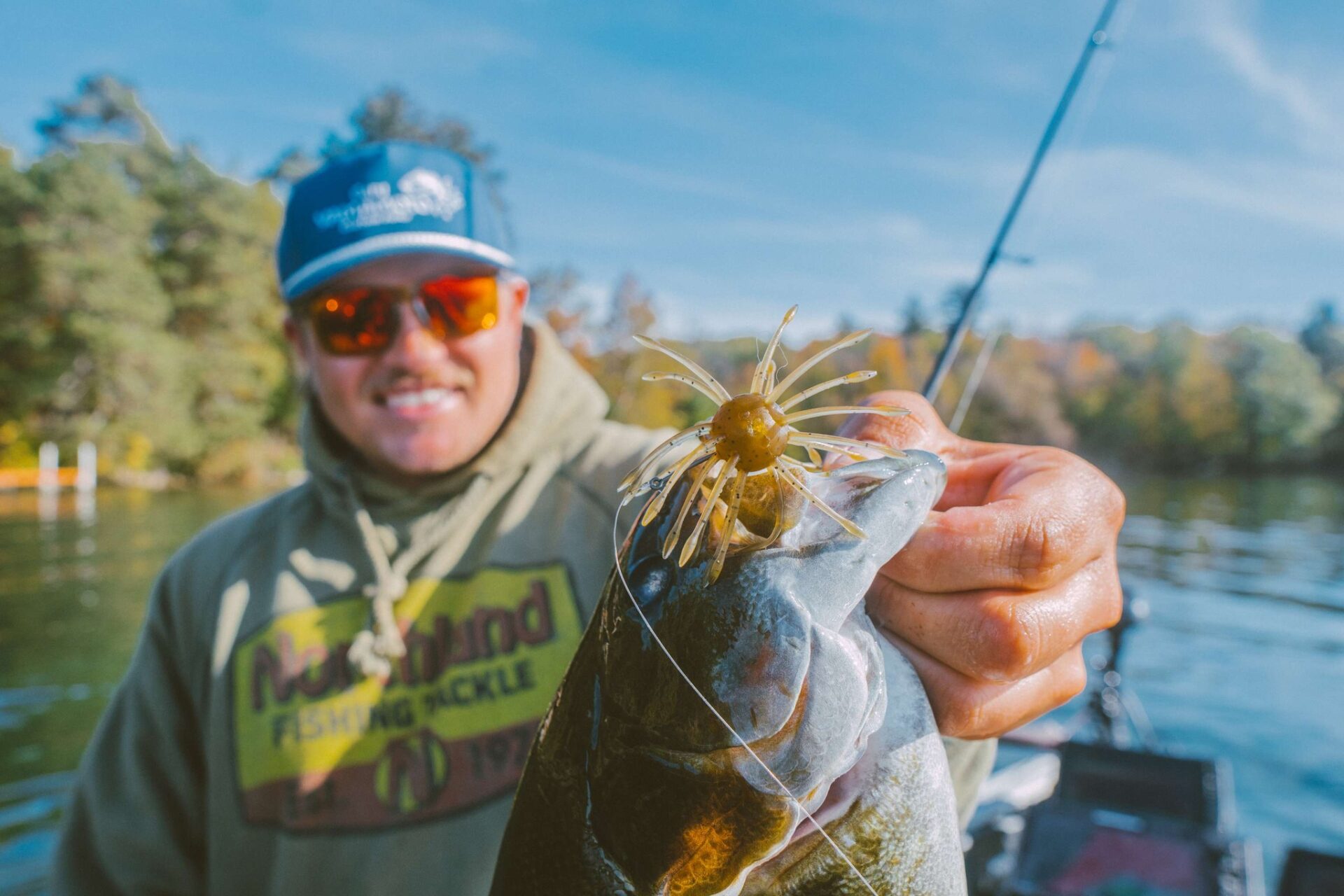
It seems like every few years something truly different shows up in bassdom and causes a shockwave in the tackle industry. The original Rapala minnow bait made a big impact waaay back in 1936. The Creme worm started the plastic worm craze in 1949. The Bagley Big O helped start the modern crankbait pedigree in 1972. Herb Reed’s Slugo started the soft plastic jerkbait genre in 1988. Gary Yamamoto’s Senko had a legendary effect on the tackle marketplace starting in 1996. Lately, it’s been a plethora of minnow baits fished on jigheads with forward facing sonar.
What do all of these lures have in common? They generally resemble something bass eat, right?
Well, the latest hot lure trend is something you’d probably never predict, and at first glance doesn’t resemble anything a bass would consume.
Known as “urchin” baits because they
resemble a sea urchin with a central sphere and numbers of spiky arms, these lures are quickly gaining a following among bass anglers looking for an edge.
Some of the more popular and available versions include the Yamamoto Uni, the Hideup Coike Lure, and the Hag’s Baits Prickly Pear, with more sure to come soon.
The best are made from thermoplastic elastomer (TPE) – a versatile, recyclable material combining rubber-like elasticity with plastic-like processing (injection molding/extrusion). Known for being lightweight, soft-touch, and durable, TPE is widely used in automotive seals, medical tubing, consumer electronics, and toys like Koosh balls.
The baits are currently available in several sizes based on the diameter of the center sphere – usually 9.9 mm, 13 mm and 17 mm and this will affect the rate of fall for the bait.
What they resemble to the fish is not something they are sharing, however, pro anglers all over the country have been using them to catch largemouth, smallmouth and spotted bass for about two years now. Japanese anglers (where the design originated) have used them a bit longer.
Some say the baits mimic a small school of minnows and that the pulsing arms trigger a fleeing baitfish reflex to eat in bass. Other say bass haven’t seen a spiky ball yet so they are curious.
The urchin-shaped Coike is a good example of these trending baits and has become one of the most talked-about baits on pro tours after anglers fishing a Lake Fork Bassmaster tournament did well using them.
The key to successfully using these new baits is understanding how to rig them and the options are many.
Many anglers choose to rig urchin style baits on a drop shot, but where do you hook it? Due to the thickness of the TPE plastic core traditional drop shot hooks don’t work well. Using a wide-gap 2/0 hook still wasn’t perfect. Angler determined the best way forward was to push whatever hook deep into the bait, past the bend of the hook.
Forward facing sonar lovers adapted the urchin baits to their style of fishing by rigging them Neko rig style and tossing them to suspending bass they noted on their screens. Rigging a large urchin bait on a wide gap hook with an insert weight is the method here.
Some anglers have also rigged up a Neko drop shot with about three inches of a tag end of line tied to a drop shot weight. As the bait descends, you quiver it as the weight acts as a counterbalance.
You can also use a treble hook and weight rig with urchin baits by attaching a split ring to the treble then thread a drop shot weight onto the split ring. Insert one of the hooks deep into the center of the bait and shake around wood cover.
Now these baits are not going to work everywhere. They are best fished in lakes and rivers that offer about two feet of visibility. Think about sight fishing!
So what kind of rod and reel is best suited to fish this new kind of bait?
One of the fundamentals of finesse fishing techniques is using light lines to increase sensitivity and reduce visibility. Fishing a urchin bait is no different. Flurocarbon lines ranging from 8 to 10-pound test are common choices that allow anglers to feel subtle bites and maintain natural lure action as well as permit the bait to sink with less resistance.
A medium-light power spinning rod paired with a 2500 series spinning reel offers the finesse needed for controlling these new baits. This setup supports delicate presentations and quick hooksets, crucial for pressured fish bites.
Will we still be talking about this odd lure next season or will it go the way of the Dancin’ Eeland Helicopter Lure? Time will tell and you won’t know unless you try fishing them.