
If you are looking to fish two of Virginia’s most iconic bass fisheries look no further than the tidal James and Chickahominy Rivers. The Chick (as it is locally known) is actually a tributary of the tidal James. Now, while both are tidal fisheries that feature brackish water that rises and falls with the tides every six hours, they are notably different in many ways.
The tidal James River officially begins at the fall line in Richmond and continues until it flows into the Chesapeake Bay near Norfolk. Most of the best bass fishing comes from a 25-mile stretch from Falling Creek down to the confluence with the Chickahominy River.
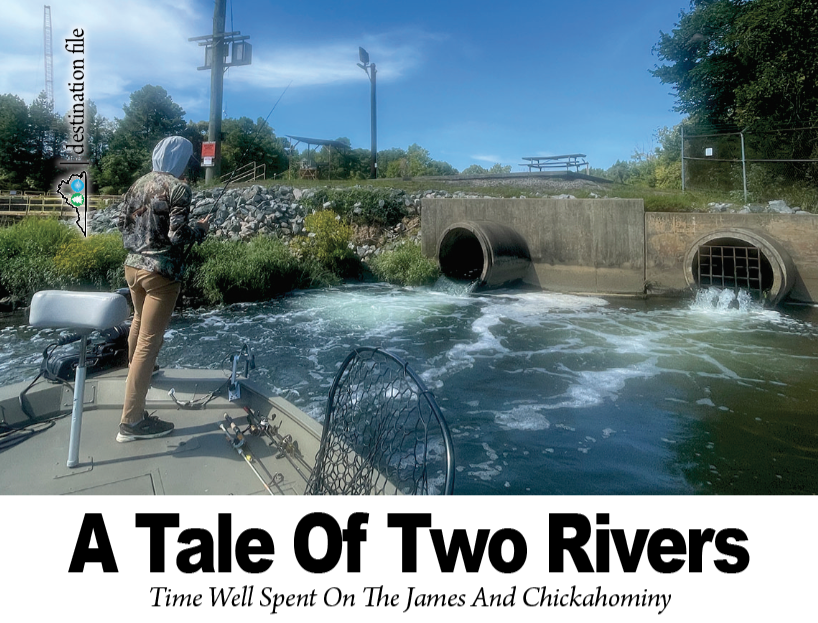
The tidal James starts out like many rivers that flow through cities – a bit dirty, a bit industrial with a lot of man-made structure to fish in the form of jetties, piers, discharges and gravel/barge pits.
As the river leaves Richmond with a series of wide oxbow turns it widens, flattens out and offers more in the way of natural structure like cypress knees, grass, weeds, logs and duck blinds.
Anglers unfamiliar with the tidal James should be aware that some of the best largemouth fishing in this system is found in tidal tributaries from the Appomattox River down to Upper Chippokes Creek — tributaries below this are more likely to be impacted by spikes in salinity.
Fishing for largemouth in the main stem James is best above Hopewell — below this there are only isolated pockets of suitable bass habitat available in the river.
The larger tidal creeks between Hopewell and Hog Island provide excellent largemouth habitat, with abundant shoreline structure, such as old pier pilings and downed trees adjacent to channel drop-offs, as well as large expanses of vegetated tidal flats.
The Chickahominy River flows out of Walker’s Dam near Providence Forge, just west of Williamsburg and meanders 22 miles down to Rt. 5 where it joins the James. The upper Chickahominy boasts vast fields of lily pads, cypress trees and a few small creeks to explore. The middle Chickahominy has fewer lily pads and more docks and also some larger creeks like Diascund. The lower river has still fewer pads, but plenty of creeks to explore like Blackstump, Yarmouth, Shipwreck, Gordon’s and Tomahund, each with dozens of duck blinds, cypress stands and other hard cover to fish.
Whereas much of the James River can be murky with silt-laden water, the Chickahominy’s vast weed beds and Chickahominy Lake tend to create much clearer water, at least in the upper sections.
Recently, I had a chance to revisit both fisheries, the tidal James with a member of the Lake Anna Elite Anglers youth fishing club and the Chickahominy with my son, a graduate of the Virginia Tech Fishing Team and the Louisa Lunkers (precursor to the Elite Anglers).
Fishing with youth is easier for me now since I’m 57. I’ve always enjoyed sharing all aspects of the fishing tradition; the patience, the decision making, the record-keeping, the physical skill, mastery of boat control, the strategy associated with tournament fishing, especially with a young, receptive mind. And while I’m not really very agile anymore, I do consider myself spry, and despite my white hair and crow’s feet at the eyes, I still can fish all day long and seem to be able to relate to young people well enough.
So, when the opportunity came to me to boat captain for a member of the Lake Anna Elite Angler B.A.S.S. Nation, I thanked my Maker for putting the young man in my life, and decided it was time to widen my fishing partner list. I hoped it would be time well spent.
Turned out I really liked the kid. He is quiet, humble, had good aptitude, bought himself a TRACKER boat and fishes hard. He catches fish, too. He reminded me a lot of my son, who is now 24.
I carried the young man with me on a recent outing to the tidal James, a place I do not fish often. We arrived around 8:15 am as the tide was near dead low and launched at Osborne Landing. It had been some years since I fished the James (six years ago with my son in a Fishers Of Men event), and I basically fished much of the same stuff we fished back then like jetties, sea walls, docks and the mouths of barge pits within a few miles of the ramp. We tried crankbaits but never had a bite. My young partner likes fishing a Ned rig so he eventually settled in with that. I switched around from crankbait to spinnerbait, Chatterbait to drop shot and even a Texas-rigged craw.
That day the bite was tough and the catch sparse; I think we figured out many areas where the fish were not, which is important if you are preparing for a tournament.
To me the biggest takeaway from the trip was not a livewell of bass but the fellowship I cultivated with a young person. On the ride to the ramp we chatted and listened to music. In the boat we focused on trying to put together the fishing puzzle for the day – we only got the corners, but we had fun.
Fishing with young anglers is important. I always enjoyed doing so and continue to fish with my son, but I’ve been away from the boat captaining since my son graduated high school in 2020 and had forgotten the impact one can have on a young person.
As a long time youth soccer coach I saw first hand how impactful a coach can be in the lives of kids. Teachers have a similar place in society. My mother was a career teacher and my daughter is a teacher. Fishing mentor/teacher is no different. It isn’t just about catching, it’s also about how an adult can show a youngster how to conduct themselves when they don’t catch fish and when they do catch fish. How to safely operate a boat. How to fish in a crowd respectfully. When it’s ok to be assertive. How to avoid vanity and pride.
Yeah, there’s a lot more going on when a kid steps in my boat than just thinking two casts ahead, another lesson I teach.
As in other tidal rivers of the region, the James was historically not known for its trophy potential, but that changed in the past 20 years with the introduction of the stocked tiger bass or the N1/F1 hybrid largemouth. This cross between a a Florida strain and a northern strain largemouth bass grows quickly and thrives in the James and Chickahominy River systems and is the main reason why eight-pound bass are no longer considered unusual here.
Many fishing tournaments are held on the tidal James out of Osborne Landing as well as from Hopewell Marina at the mouth of the Appomattox. Osborne Landing is in the upper James while Hopewell Marina services the lower river.
Like me, most anglers launching from Osborne will fish the Dupont Pit, the Meade Pit and the many jetties and old piers that protrude from the river banks, visible at low tide but nearly covered during high tide.
Anglers launching from Hopewell will seek out bass in creeks like Herring, Flowerdew, Powells, Wards and Upper Chippokes and fish spatterdock, lilypads and sunken logs.
River veterans have a bunch of lures they call on throughout the year including a small, yellow belly and black-backed crankbait, a purple/power blue tail ringworm, a white spinnerbait, a Chatterbait, soft plastic jerkbait (for use in the pits when the water is clear), a buzzbait and a popper.
Rarely are you fishing for schooled, offshore fish on the tidal James. Bass here are chunky and hold on shallow current breaks that lessen the effect of the strong tides and offer ambush spots when food washes by.
For the rest of the fall and into winter, I asked, Donnie Bell, one of the river’s veteran anglers and the owner of James River Tackle Co. in Hopewell what anglers visiting the tidal James River can expect.
“Bass on the tidal Appomattox and James Rivers this month should be very interested in topwaters like Rico’s, buzzbaits and Whopper Ploppers fishing early along shoreline wood,” he told me. As the sun climbs, he suggested pitching a ringworm or a tandem willow-bladed spinnerbait around slightly deeper wood cover.
On the main tidal James River, Bell suggests visiting anglers fish blowdown trees that stick out into creek channels with a 1.5 to 2.5’ squarebill crankbait. The main river jetties near Dutch Gap will also begin to turn on this month for anglers using crankbaits and worms.
Bell wanted to thank all the anglers that fished his Weekend Series tournaments this season. as well as everyone that offered help after his shop flooded out last month. He and Erica are working to get the store back up and running after 18” of water flooded it in August.
Now the Chickahominy River is a totally different animal than the James. My son and I visited that river in early August this summer, again fishing areas I have been fishing for the past 30 years. I’ve fished with river greats such as Kelly Pratt and others that have come and gone and learned some pretty good river secrets, many of which still hold up today.
While my son and I’s day didn’t produce any noteworthy bass we did end up with enough for a nice pic at the end of our day and some good fellowship. He’s a married man now with a job and many other responsibilities that come on quickly in your 20s. The fact that he still wants to fish with me is wonderful and I am grateful to remain close with him. We talk of many things and reminisce of past trips and adventures.
All this is due to a foundation built years ago, when he was younger, in a boat or in the woods. While I am far from a perfect father or example, I tell him to learn ALL the lessons I offer; the good and the bad. He’s watched carefully, as most young people do.
That day on the tidal Chick we launched from Rockahock Campground’s ramp at Walkers Dam and mostly fished around the sunken barges at Lanexa Island. We caught a couple down at River’s Rest and I pulled one from the docks at Chickahominy Haven. The middle river was uncharacteristically muddy/stained and that threw me off a bit. Up river was its usually, clear, vegetation-filled self. The bass there were VERY shallow, behind the lily pad line even at low tide and willing to inhale Neko-rigged stickbaits. Water temperatures were 82-86 that day where we fished until 3 pm as the tide ebbed and then rolled back in.
According to Virginia Department of Wildlife biologists, largemouth bass populations in the tidal James and Chickahominy rivers remain strong. A cool, rainy spring kept water temperatures lower than average heading into summer, followed by a very dry, warm fall. The heavy flows and numerous storms of spring and early summer may have impacted recruitment, leading to lower juvenile abundances. While not ideal, it is normal to have good and bad years- poor recruitment in 2025 is not expected to negatively impact population health going forward.
A dry fall meant salinity levels were higher than average in the James River above Weyanoke Point and Chickahominy river up to the Thoroughfare- including tributaries. Higher salinity drove bass further upriver to seek out freshwater. As a result, DWR Biologists predominantly saw smaller bass in downstream habitats and only saw larger bass higher up in the systems.
In the Chickahominy, one to three-pound bass dominated the catch at downstream sites, in both the main stem and tributaries; while larger bass in the five to nine-pound range were caught high in tributaries and above the Thoroughfare. There are plenty of opportunities to catch five to six-pound bass, with the potential to land bigger fish over eight.
In the James, the highest catch rates and largest bass were caught in Herring and Queens creeks. Smaller creeks, like Queens, Flowerdew Hundred, and Kitten creeks have abundant, high-quality habitat. Despite their smaller channels, they support healthy populations and offer opportunities to catch trophy bass.
I want to encourage anyone reading this to consider being a boat captain for the young anglers fishing the B.A.S.S. Nation of Virginia, Inc events. There are teams pretty much all over the W2 circulation area and the Lake Anna Elite Anglers are located in central Virginia. You can email lakeannaeliteanglers@gmail.com. If you do serve as a boat captain I think you’ll remember it as time well spent no matter where you fish.