
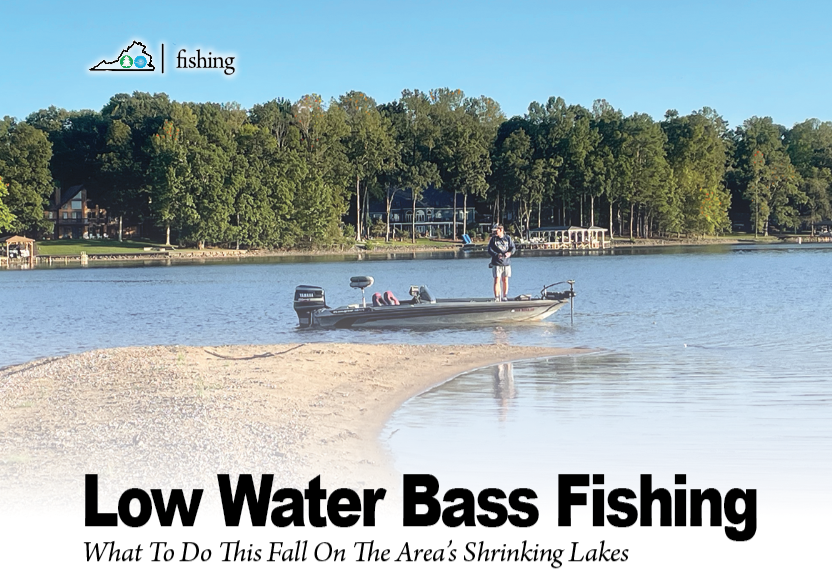
Smith Mountain, Buggs Island/Kerr Reservoir, Lake Anna and many other smaller lakes around the region have feltl the effects of a dry spring and early summer with each at the lowest level in years. This, combined with seasonal fish movements can make fishing this fall challenging to say the least. When faced with many of your favorite fishing holes being dry or too shallow to hold fish, the options are not fish or learn something new. The latter option is what this article will cover.
So your home water or where you have to fish in a tourney is now super low, you’re not being picked on. In fact most of all this low water manifesting itself now started back in the spring when already low water levels were not raised due to scant rainfall. This creates a situation where your go to patterns and places are often no longer productive and frustration ensues. Let’s start with a little fish detective work before we get to tactics.
Where do bass go when the water recedes and their normal haunts are dry? Well, think about this, while many normal water level spots are no longer fishable, they are fish and they must live in water so in many cases they just readjust to the new water line and find suitable structure. It really can be this simple. Stick with the fish you know and track them to new neighborhoods that coincided with the new water line.
This tactic is common in shallow lakes with plenty of cover, think Chickahominy Lake and the many other smaller reservoirs around the region.
Now, when it comes to schools of fish, those concentrations that top tournament anglers often target and find for big wins, these can be a little trickier to relocate as they are already fairly nomadic. Schools that normally stalk the shallows may pull a hundred yards away or more and worse: they may suspend!
These are the scenarios anglers face during periods of low water. Here are some tactics I’ve found over the years on Lake Anna and in my travels around the state that can up the odds when you have to fish a low water lake.
Ok, so your favorite stretch of docks has five inches of water on it and that underwater ridge of shallow rock that held a bunch of bass last year is now out of the water. Now what?
Well, let’s keep it simple and look for the fish in the immediate vicinity – like the stumps located about 10 yards away from the docks or the channel bend just off that rock. With today’s forward facing sonar it shouldn’t take long. If you aren’t a TV fishing guy, no problem, try running a shallow diving crank bait like a Berkley Squarebull through the area a few times – it’s great for fish that have relocated to structure in three to five feet of water.
No bites but you still think you see fish on those stumps? Pitch in a drop shot with your favorite color straight tail worm and tickle a nose or two and see what happens.
That channel calls for a hard plastic jerk bait like a Megabass Vision 110. This series now has a couple sizes and versions that dive to various depths. Generally, though the shallow running, suspending 110 Jr are best for fish on a channel break or suspending over it.
This tactic tends to work better on sunny days with about a 5-8 mph breeze. Suspending fish are very visual and a jerkbait reflecting sunshine helps draw them in. The breeze can move baitfish into more predictable areas as well as help make your beautiful hunk of plastic with six hooks look a bit more enticing at rest.
Let’s talk about schooling bass for for a bit now. Schoolies are easy in June and July but now the hump or long main lake point they were hanging on is dry and growing weeds. What now?
Watch and listen. Look for birds like terns or sea gulls to indicate where these schooling fish have gone. Listen for their cries and the fishes’ splashes. Or, with no indicators of where to fish in open water it’s time to tie on a dog walking bait like a Berkley J Walker (I use the 120 size in bone and call it the Dirty Banana) and make long casts to see if you can turn on a school that is otherwise hidden below the surface cruising or lazing.
Work this bait as fast as your arm allows and never stop walking it until the rod loads up with a fish as you have to incite the competitive nature of schooling bass that often bite right to the boat.
What about weed beds during low water? Find them them and fish them because bass love weeds in the fall. When hard cover like docks and stumps are out of the water, fall back to some weed edges or clumped grass and you should find bass. All weed beds are not made equal, however.
With a good pair of polarized glasses like the Hank Cherry floating Hobies I use look for baitfish on the ends of weed lines and in the “room” between clumps of grass. If you have baitfish in the weeds, you should have game fish like bass.
A good lure to use around submerged or clumped weeds is a vibrating jig. The original Chatterbait, the Berkley Slobberknocker and various locally-produced vibrating jig baits call fish to you from the grass and hits can been jarring. Always tip your bait with either a paddle tail or an other plastic trailer that offers a come hither action to curious fish that follow.
One lure that is often overlooked these days is the spinnerbait. Use one that has the same blade size as baitfish in the grass and a suitable color and you should be able to fish over grass and around clumps. Trailers are not critical but blade size and color is.
If fish are using the weed edges to trap baitfish try tossing out the spinnerbait to the swirls, let is flutter sink and only begin turning the handle as it nears the bottom. You want your bait to fall through the baitfish to the bass below and then take off – simulating confused shad or herring that the bass will engulf unknowingly just as you turn the reel handle.
Other areas that often hold fish during periods of low water include those with current and those with massive schools of bait. The former can be a discharge, wind current through a narrow spot (think bridge) or a flowing creek. The latter, where you find schools of bait can occur in the middle of the lake over 35’ water. Target the current bass with soft plastic jerkbaits that match the size of what the fish are feeding on. Often you’ll need to use a small jerk bait in the fall to mimic small baitfish. For the big schools of bait situations, you’ll want to target these bass with small topwaters like a Pop-R,Tiny Torpedo or a small crankbait. A swimbait burned along the surface can also trigger strikes.
When all else fails in a low water situation, just start grinding with a drop shot. Pitch it to everything you see on your depth finder. While schooling fish rarely respond aggressively to a drop shot, you can pick away at cruising and bass posted up on hard cover like rocks and wood in two to 10’ of water.
In lakes with a lot of vegetation like Chickahominy Lake don’t rule out frog fishing during low water and high skies. When all those pads and grass are dry switch over to fishing hard cover with the frog like deeper docks (skipping under them good, too) and floating docks, really anything that creates a shadow.
Ok, now you have some good options to try the next time you go fishing this fall where the water is low. As long as you can launch and fish try these tactics with renewed confidence. I’ve fished Lake Anna and many other lakes when the water is low and found with a little creativity you can still catch plenty of fish.