
With 2025 in the rear view mirror it’s time to look ahead at what new outboards we can expect to see on rigs this coming season. Fuel prices were relatively stable last year so many anglers enjoyed using their fishing boats, and we can only hope that remains the case in 2026. Some trends we continue to track include further improvements in electric outboards and more artificial intelligence influence in boating. With that all that in mind here’s what to look for in dealerships and marinas this season.
Honda
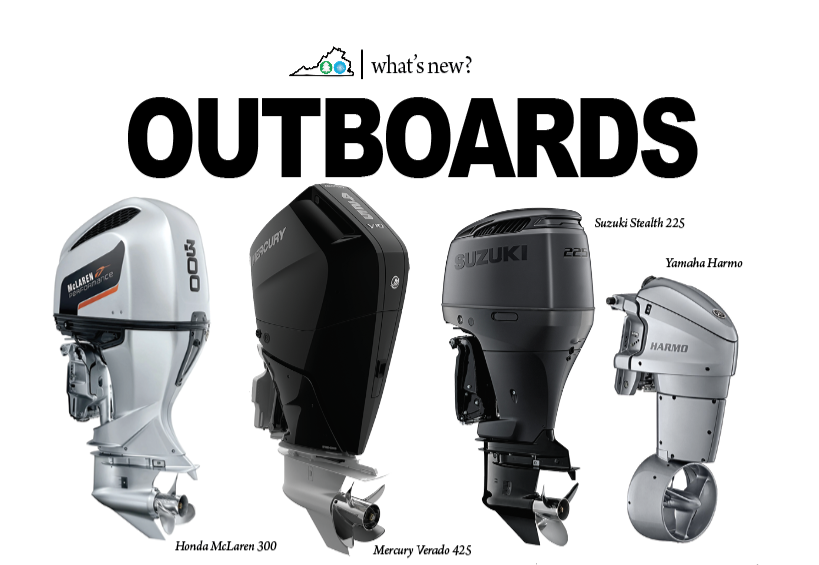
Honda’s entry into the big outboard market was a success with the introduction of their BF350 V8 back in 2024. While they are engineering even larger outboards, Honda has introduced an update on their proven 200/225/250 HP platform some area bass anglers have taken to that they are dubbing the M300, which is tweaked by McLaren Racing better known for its Formula 1 team.
The McLaren Performance M300 is the result of collaboration between Honda Marine and McLaren Engineering, two formidable technology partners.
McLaren Engineering boasts a storied history of North American racing heritage as well as specialty engine and vehicle projects since the founding of the original McLaren Engines Inc. in 1969. As a supplier to Honda for the past decade, McLaren Engineering has demonstrated its expertise in high-precision, high-quality engine component manufacturing.
Now, the McLaren team extends its research and development capability and performance excellence to Honda Marine outboard motors.
The all-new McLaren Performance M300 engine is based on the existing high-power Honda BF250 3.6L V6 marine platform. Using its precision engineering technology expertise, McLaren Engineering is performance-tuning base models of the BF250 to create the M300. The Honda M300 gets its extra 50 sea horses (compared to the BF250) with the addition of a new high-lift camshaft that boasts more aggressive valve timing, a new Engine Control Unit (ECU) that controls engine protections and boosts efficiencies (IG mapping, Knock Control, etc.), new fuel injectors that offer increased fuel supply, a higher red line (6,400 rpm max vs 6,300 revs for the BF250) while still generating excellent fuel efficiency. In order to get all that extra power users must use 90 octane gasoline to make the magic happen.
Honda’s exclusive VTEC technology offers a superior combination of power, torque, and fuel economy. Multi-port Programmed Fuel Injection adds both easy starts and improved fuel efficiency without sacrificing performance. It delivers precise amounts of fuel and air to each cylinder, for easy starting, instant throttle response, and excellent fuel efficiency. The M300 offers Honda’s legendary quiet performance, meaning you get to enjoy more of the great outdoors and less engine noise. The dual channel, indirect-air-circuit induction system in the cowling improves airflow, enhancing performance while helping funnel moisture away from the throttle body.
The M300 is offered in 20, 25 and 30-inch shaft lengths for multi-engine configurations. As of this writing, the new McLaren V6 is available as an OEM option to boat builders who are part of the Honda program.
Mercury
For 85 years, Mercury Marine has remained committed to offering innovative solutions that power boaters’ best experiences on the water. This includes the widest range of outboards in the industry, from high-horsepower V12, V10, V8 and V6 engines, to the innovative all-electric Avator™ outboard family.
Is Mercury going electric? Yes and no. Here’s their official statement: “We intend to be the leader in both internal combustion and electric outboards. Our motivation is simple: We’re the innovation leader in the marine industry, and we want to use our resources and knowledge to make boating more accessible to more people, while also providing sustainable solutions that help protect our environment. We’re doing this across all our product lines, and electrification furthers this mission.”
Avator is a Mercury sub-brand, like Verado® or Pro XS®. It represents a family of low-voltage electric propulsion systems. In both spirit and name, Avator is a combination of “Advanced” and “Thor” – Thor being Mercury’s first-ever outboard model. It gives a nod to both the history of innovation and Mercury’s commitment to leading the industry in electric propulsion.
Three Avator models are currently available at Mercury dealers: 7.5e, 20e and 35e. Mercury will have Avator 75e and 110e outboard models available later this year.
The Avator model designations are not based on horsepower. They’re derived from a more common means of measuring power among electric mobility products: watts. More specifically, the model designation is based on the amount of propulsive power each outboard generates at the prop shaft, with the decimal point shifted two places to the left. For example, the 7.5e models rates 750 watts at the propeller shaft and 110e rates 11,000 watts.
While these ratings can be converted to horsepower, a simple conversion doesn’t paint a full picture of the performance. The electric motor design used in Avator outboards generates high torque and instant throttle response, resulting in faster acceleration than what you’d generally experience from internal combustion outboards “rated” at the same power level.
Each Avator outboard is designed in tandem with controls, prop, batteries, display and a mobile app as part of a complete electric propulsion system. While the batteries all feature lithium-ion chemistry, Mercury worked with its partners at Mastervolt® to optimize a battery system for each outboard. This includes portable battery packs and modular systems for certain models to let boaters choose how much power to bring along.
Avator electric outboards are ideal for use on bodies of water where internal combustion engines are restricted or prohibited, but that’s only just the start. They’re designed to power a range of small boats, from inflatables and jon boats to small pontoons and even some small fiberglass runabouts. They’re also popular for powering tender boats and as secondary power on sailboats. Electric outboards are not “go-fast” motors. They’re favored by boaters who prefer a quiet, immersive experience. And because they’re so simple to use and maintain, they make a great choice for new and experienced boaters alike.
Just like with an internal combustion outboard, the range and runtime for an Avator outboard will vary based on the water conditions, the number of batteries (amount of fuel) and how the outboard is operated. Avator batteries are sized to give approximately one hour of runtime at full throttle. By adding batteries or operating at a lower throttle position, you can extend range and runtime.
Mercury is the only American-made outboard left and its line of ProXS outboards continue to be very popular among anglers. The motor is standard issue on many boats including the Bass Pro Shops line of Nitros, Tritons and Rangers.
The ProXS line up includes 115, 150, 175, 200, 225, 250 and 300 hp models. The 115 and 150 utilize an inline four-cylinder engine (2.1 l for the 115 and 3.0L for the 150). The 115 weighs 359 pounds and has a 35-amp alternator while the 150 weighs 456 pounds and has a 60-amp alternator.
Moving into the range of performance outboards for tournament bass boats the 175 ProXS is based on a 3.4L V6 while the 200-300 outboards are build around a 4.6L V8 DOHC engine that weighs just 511 pounds with a standard-setting 85-amp alternator. The ProXS outboards have a three-year warranty.
While not intended for bass boats, Mercury does a have a new V10 5.7L outboard that is available in 350, 400 and 425 hp versions. This beast weighs in at just 695 pounds, has a 150-amp alternator and runs on 87 octane fuel.
Suzuki
Suzuki will add a new motor to its Stealth line in 2026 – a DF225. This is a 55-degree V6 outboard that weighs in a 606 pounds with a cc displacement and a 38-amp alternator. The Stealth engines all run on 89 octane and come with a standard five-year warranty.
If you see a Suzuki on a bass boat it’s probably a DF250 Stealth. Like all Stealth engines, Suzuki cloaks the DF250 in matte black, however this engine is only one in the series with raised black lettering. The 250 weighs 624 pounds and utilizes DOHC 24-valve technology in a 245 cc block that comes with a 54-amp alternator and fly-by-wire digital technology that uses SPC2.0 controls that integrate with auto trim, a keyless start ignition and a new digital pedal/throttle. The skeg has a left-right asymmetry curve to assist manuvering. The gear oil drain plug and anode were moved to behind the water screen and the DF250 has stiffer engine mounts for improved stability at speed.
Suzuki offers Stealth outboards for anglers from 350 hp down to 115 hp.
Tohatsu
For 2026, Tohatsu is releasing new or upgraded 8/9.9 horsepower and 15 horsepower EFI models, while its portable outboards, including the 2.5hp and 3.5hp, feature new designs with improved ergonomics and oil-spill-free storage. The MFS50 HP model now has more low-end torque with an improved gear case and variable idle speed control. Additionally, Tohatsu has introduced a 6kW, 48v electric outboard in partnership with Ilmor, and separately, a 6kW electric outboard.
The MFS20 HP is now available with battery-less EFI, which makes it lighter and offers improved fuel efficiency at wide-open throttle. This 20hp battery-less electronic fuel injection four-stroke produces exceptional torque and top end speed, with low vibration. EFI’s are a big plus on smaller outboards because they offer easy startup with no choke required and smooth, crisp acceleration throughout all RPM ranges. Another added benefit of an EFI versus Tohatsu’s previous carbureted outboard is the fuel efficiency at wide open throttle, which allows boaters to go up to 50% farther on less fuel.
Also available on many 15/20 horsepower models is the Power Tilt feature. Power Tilt is ideal for inflatable, small fishing skiffs and pontoon boats.
Tohatsu’s larger engine offerings above 140hp are the BFT150D, BFT200D, BFT225D and the BFT250D. If you look closely and compare specifications one will see that these outboards are manufactured by Honda Marine and painted blue, with Tohatsu decals. The BFT150D is based on the Honda 2.35-liter in-line four-cylinder design, whereas the BFT200D-225-250 are based on the 3.6-liter V6 Honda format.
Yamaha
The Yamaha SHO line up doesn’t look to be changing much for 2026. The most popular option is the V6 VMax SHO 250 (also available in 225 and 200 hp versions). The 250 hp 4.2L V6 outboard runs on 89 octane fuel, weighs in at 529 pounds and has 70 amp alternator. This the motor you’ll find on most of the tournament SKEETER bass boats. It comes standard with a three-year warranty.
The Yamaha 3.7kW HARMO electric outboard system provides 227 pounds of static thrust (9.9 hp) and can be used in single and twin configurations. Its integrated digital electric steering, Helm Master® EX compatibility (in twins), and 140-degree steering angle deliver crisp response and precise steering. It can maneuver boats up to 32 feet in length in most conditions and is perfect for horsepower- or internal combustion-restricted waterways. The motor weighs 141 pounds.
Yamaha incorporates a lithium-ion battery solution* for Yamaha’s HARMO Electric Outboard. For boater convenience, HARMO single and twin outboards have the option of using lithium-ion 48-volt batteries or Yamaha-approved traditional 12-volt batteries**. HARMO applications also benefit from added assurance with the Stage of Charge (SoC) battery status right on the gauge, allowing boaters to plan time on the water with confidence.
HARMO’s powerful rim-drive technology and mid-section Digital Electric Steering (DEC) generate immediate response to boater controls and vigorous thrust– perfect for smooth maneuvering around the docks or slinking over a favorite fishing hole.