
A question popped up recently relating to when I started writing for outdoor publications.
The question stumped me a bit, so I looked back and read through a few articles I wrote nearly 30 years ago. It was a little humbling as a thousand days on the water will most certainly add insight and bust a few myths along the way. One topic that I have gone back and forth on over the years is, Big Bait = Big Fish.
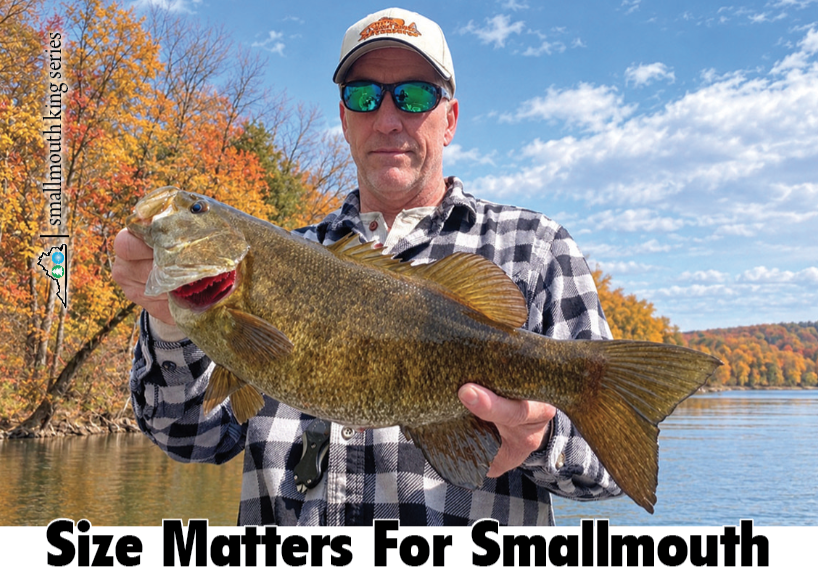
I honestly believe the person who first coined this phrase never targeted smallmouth. Those crazy fish do not care how big the bait is, they will try to eat profiles over half their size. Attacking lures that would be nearly impossible for them to swallow.
Anglers who regularly target smallmouth have a story or two of bass that not only fight well beyond their year class, but are regularly caught on lures they have no chance of swallowing. So where the concept of big baits, big fish applies to many species, from my experience it can at times fall short on smallmouth.
There are times during the year when location, profile and presentation are more important than the size of a given bait. That said, there are instances where size matter; a time to up size and a time to downsize when targeting big fish.
As we come into November, bass are looking to bulk up for the long cold winter. While bass can be taken on smaller profiles, the colder nights, drop in water temp and dwindling daylight hours force bass to target larger forage. This is especially true with trophy sized fish. The need to build up a fat reserve before winter arrives, will often make them easier to target. Up sizing your lure selection makes perfect sense. Larger bass need to feed and larger prey is needed to build up that reserve.
For anglers looking for a guideline of when this occurs, late October and early November when the water temperature drops into the 50’s. Trees will be dropping leaves and vegetation such as eel grass and other aquatic foliage will be dying off. This is a key trigger to up-sizing lures for larger bass.
Topwater Plugs
While top water is a go-to lure for the majority of the season, come November, I am more prone to have a large walk-the-dog plug on the ready. Many anglers prefer mornings and evenings, but autumn sky’s often switch from sun to clouds during the day and when it does, I encourage clients to pick up the top water as cloud cover rolls in.
I recall one November day when dark clouds would block the bright sun for only minutes at a time. We had the boat in an area where we could reach shallow water when the clouds came in, and deeper water when they passed and the sun brightened the sky.
As soon a cloud would block the sun, the top water bite was on. Even if it was only for spurts of short intervals between sunny and cloud cover, the surface action was amazing.
Suspending Lures
Larger jerkbaits and segmented glide baits are another lure we will spend time throwing. This is not to suggest that smaller suspending jerks do not work, but if there is ever a time to see big bait, big bass in action, it is now. River smallmouth will dine on creek chubs and fall fish that are five, six even seven inches in size. Use that to your advantage. It is easy to over-work these larger suspending lures. My advice however is to work them as slowly as possible. Slower subtle movements make these larger profiles
Big Swimbaits / Paddle Tails
In most instances, minnow forage is quite visible. Receding/dying vegetation eliminates a portion of their shelter making them easier to spot. Sizes will range, but it is common to see schools of larger minnows and even bait balls as the natural cover is gone. For anglers who prefer smaller swimbaits in the 2.5 to 3.5” range, I recommend throwing larger, longer profiles. Even shifting to 4 – 4.5” can make a significant difference.
Crawfish Profiles and Swim-jigs
Most believe that crayfish hibernate and while their activity does slow down, they are still a big portion of the smallmouth diet throughout the fall. In warmer months I honestly prefer smaller profiles for bass. Those three-inch baits, give or take a quarter inch are perfect. Tubes, craw and Ned bug profiles all work and my tackle bag is loaded with them. Come early November, I tend to switch to larger sizes such as four-inch or longer profiles when rigged on a swim-jig with a crawfish colored silicon skirt.
If crankbaits are your preferred crawfish profile, I recommend throwing larger bodied cranks in the 1.5 to 2.0 sizes. They generally make more commotion and can at times generate more strikes than smaller 1.0 sized crankbaits.
Since we are on the topic of “Size Matters” this article would miss the mark to not discuss later in November and early December when smallmouth, yes trophy smallmouth will dial in on smaller forage.
The difference in catching bass early November verses late November can come down to a matter of lure size once again.
Once the water temps in the river drop into the middle to upper 30’s, downsize your offerings. Teaser sized tubes and Ned profiles that are 2.5 to 2.75 inches are ideal for this transition and will produce throughout the winter. Select swimbaits that are around the three-inch mark and swap out this large profile suspended jerkbaits for smaller sizes from 2.5 to 3 inches (60-80mm).
When the river water temperatures drop below the 40 degree mark, these smaller sized profiles are going to get more strikes and bigger bass than larger profile lures.
November is an interesting month for sure, and size matters. Selecting the right size lures in those specific conditions is the key to putting larger bass in play!
Author Chris Gorsuch is a licensed charter guide in the state of Pennsylvania. He started the Reel River Adventures guide service in ‘07 and spends 225-250 days on the water annually. His home base is on the Susquehanna River. Follow his daily fishing reports on Facebook ‘Reel River Adventures-RRA’ & Instagram @Chris_Gorsuch