
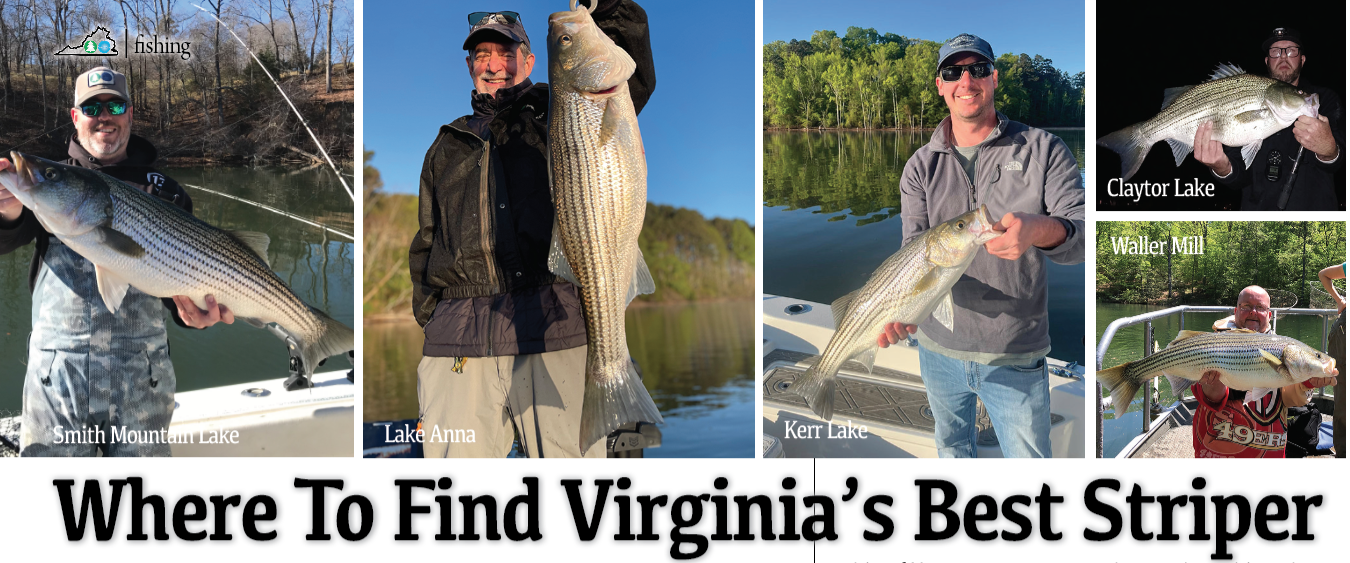
Striped bass (Morone saxatilis) are one of the most sought-after gamefish along the Atlantic seaboard. Millions of anglers fish for them each year from Maine to the Gulf Coast.
In addition to the anadromous striped bass population in the Chesapeake Bay and along the Atlantic Coast, Virginia boasts some of the best inland, land-locked striped bass opportunities you can find in the east.
The Virginia Department of Wildlife Resources (DWR) manages these inland, land-locked fisheries. Large impoundments across the state like Smith Mountain Lake, Buggs Island Lake, and Lake Anna to name a few, provide excellent opportunities to target these fish without having to travel to the coast. Managing striped bass in these systems requires a keen understanding of multiple variables—two of the most important being habitat and forage.
Habitat
Striped bass can thrive in freshwater systems under the right conditions; however, they can’t live in every lake. These fish are a temperate species, requiring cooler water with ample amounts of dissolved oxygen. Warmer weather in the summer months affect both the water temperature and the levels of dissolved oxygen in large lakes.
The thermocline is a thin layer of water that separates the warmer, higher-oxygenated water near the surface and the cooler, less oxygenated, deep water below. Below the thermocline, low dissolved oxygen levels can make life unsuitable for most fish species. Above the thermocline, the water can warm beyond a fish species’ tolerable range.
In the summer months in Virginia, striped bass can get pinched out of cool, oxygenated water depending on where the thermocline sets up and the unique hydrology of each lake. Above the thermocline, they can be in water that’s too hot, and below, they might be in water without sufficient oxygen.
It’s important to note that hybrid striped bass, which can tolerate warmer water temperature regimes than pure striped bass, can be an alternative option in fisheries that feature less-than-ideal striped bass habitat. Claytor Lake is currently stocked with hybrids due to this issue. Ultimately, habitat availability plays a major role in DWR’s management decisions on striped bass impoundments.
Another system that DWR manages with both pure striped bass and hybrids is Lake Anna. “Lake Anna is a wonderful fishery despite the habitat,” said John Odenkirk, DWR fisheries biologist. “Large, adult stripers prefer cool, highly oxygenated water, and that’s just not here.” But the power plant outflow into the lake keeps the water circulating enough that the traditional thermocline, with a warm, oxygen-rich upper layer and cool, oxygen-poor lower level, doesn’t have a chance to form fully in the summer. This provides fish with water quality adequate for juveniles and young adults. Because of the lack of habitat for larger striped bass and resulting slow growth, Lake Anna fishing regulations favor the consumptive striped bass angler with a 20-inch minimum and a four-fish bag per person.
Different regulations are often in effect in systems that maintain exceptional habitat for larger adult striped bass. As an example, the highly oxygenated, cool water habitat at Smith Mountain Lake allows striped bass to grow and thrive at larger sizes. Smith Mountain Lake fishing has high trophy catch potential, and DWR regulations reflect that with a 30- to 40-inch protective slot limit from November 1 through May 31 and a daily two-fish bag per person. From June 1 to October 31, there is no length limit, and this slot doesn’t apply to the two-fish bag due to concerns of catch-and-release mortality during the warmer months of the year.
Forage
A strong forage base is essential to a thriving striped bass fishery in an inland system—fish need to eat! All of Virginia’s inland striped bass fisheries are dependent on abundant shad populations. The forage can vary from system to system, but you need an abundance of gizzard shad, alewife, blueback herring, or threadfin shad to satisfy striped bass appetites.
Not all systems with large striped bass are thousands of acres in size. If the habitat and forage align, relatively smaller systems can produce trophy potential.
“Waller Mill Reservoir, located in Williamsburg, is only 360 acres in size but has the potential to produce striped bass in the 20- to 25-pound range,” said Scott Herrmann, DWR fisheries biologist. “The strong forage base of gizzard shad within Waller Mill Reservoir allows stocked striped bass to grow to impressive sizes.”
The health and stability of a striped bass population in a water body directly depends on the availability of forage, or shad to eat. This is known as predator-prey balance. A decrease in the population of forage fish often results in reduced growth rates for striped bass and skinny fish. Under these circumstances, malnourished striped bass are much more susceptible to disease and infections. DWR biologists keep close tabs on shad populations and striped bass populations through annual fish population surveys, and that data informs their stocking allotment decisions.
“It’s not a one size fits all deal,” said Odenkirk. “We have to determine stocking rates for each lake individually, because each lake is different based on productivity, the zooplankton populations, and ultimately the forage base populations. We have to find the right mix for each system and the right number of striped bass to stock in each system without crashing the system. You can put in too many predators and the system collapses, leaving no one happy.”
Striped Bass Aquaculture
In addition to keeping tabs on habitat and forage availability, DWR uses aquaculture, or breeding and releasing captive fish, to maintain most inland land-locked striped bass fisheries. While the striped bass fishery at Buggs Island Lake is one of only a few inland, land-locked fisheries with a striped bass population that naturally reproduces successfully, it still needs additional levels of stocking to meet angler demand.
“Two of our hatchery facilities raise striped bass: Vic Thomas, which raises Roanoke River strain exclusively, and King and Queen, which raises both Roanoke and Chesapeake strains,” said Brendan Delbos, DWR state hatchery superintendent.
“We stock 10 to 12 waters throughout the state with total production around 1.5 million to 2 million fingerlings per year,” Delbos explained. “While we do see some limited natural recruitment in some of these waters, it’s important to note that striped bass fishing in Virginia impoundments simply would not exist as we know it today without the intervention of our hatchery staff.”
May and June are excellent months to catch your first freshwater striped bass or hybrid striped bass from one of Virginia’s many managed land-locked striper fisheries.
Knowing where to target them is just the start of what many anglers accept as a lifelong passion. Here are our top waters around the Commonwealth to target these challenging residents and some tips on how to catch them in each.
Smith Mountain Lake
Smith Mountain Lake is a 20,600-acre impoundment located near Roanoke in Bedford and Franklin counties constructed in the early 1960’s by American Power Company. This reservoir is one of Virginia’s premier fisheries, offering outstanding fishing and other recreational opportunities. Most of the shoreline is developed with residential homes but the fishing remains excellent.
Striped bass have been stocked into this reservoir since impoundment in 1963. Limited spawning habitat in the lake for striped bass prevents natural reproduction so stocking is required to maintain the fishery. On average, more than 300,000 stripers are stocked into the lake every year, however stocking was reduced to 225,000 in 2023.
A primary factor affecting that growth rate is forage. Gizzard shad are a primary food source for stripers and research has shown a correlation between striped bass growth and gizzard shad numbers in Smith Mountain Lake.
Stripers are distributed throughout the lake during most of the year but are concentrated in lower lake areas during the summer and early fall months. Coves are typically not very productive for striped bass during the summer months so anglers should concentrate their efforts on the main lake when water temperatures begin to rise.
Striped bass anglers utilize a variety of fishing methods such as drifting live bait, trolling plugs and bucktail jigs, or casting topwater lures. Anglers use live bait throughout the year, trolling is most popular during the warmer months, and casting top water or shallow running plugs is most productive in April – June at night. Jointed topwater plugs like a Berkley Surge Shad, Cotton Cordell Redfin and Storm Thunderstick are locally popular.
Most striped bass are caught between the dams and buoy 64 of the Roanoke Arm and up to buoy 40 of the Blackwater Arm. Although these are the general areas most striped bass are caught, these fish are very mobile and may change locations continuously depending on forage availability, water temperatures, and spawning.
For guided trips contact Spike’s Prime Time Fishin’ or Clint’s Striper Guide Service.
Lake Anna
Lake Anna is a 9,600-acre impoundment located in Louisa, Orange, and Spotsylvania counties, owned by the Dominion Power Company. This lake offers good striper and hybrid striper fishing.
Annual stockings of striped bass and hybrid striped bass continue in order to maintain these fisheries (other species are self-sustaining). After years of study by DWR Biologist John Odenkirk and more recently Mike Isel, it has been determined that Anna has a carrying capacity for both predators based on the lake size and forage base. Currently around 46,000 of each species is stocked into the lake each year.
Stripers grow well in Lake Anna, at least for the first few years, and quickly attain the legal size of 20 inches in about 30 months. However, growth of older fish slows due to the lack of good striped bass habitat (cool, well oxygenated water) during summer and early fall months.
Hybrid striper or wiper often school with the striper and will accept the same offerings. They tend to bite more readily during periods of hot water in shallower water, though, than the striper. In May 2023 a 14.33-pound hybrid striper was recorded and there is hope a new state record (15-13 from Claytor Lake) will be caught from Anna.
For guided trips contact McCotter’s Lake Anna Guide Service at 540.894.3540
Claytor Lake
Claytor Lake is a 4,363-acre impoundment of the New River, stretches northeastward across the Pulaski County countryside for 21 miles in southwest Virginia
Striped bass and hybrid striped bass combine to create an important fishery at Claytor Lake. Poor habitat conditions (low dissolved oxygen levels at their preferred temperature at depth) for striped bass in summer 2016 caused a striper kill, but, with good habitat years since then, the striped bass population is recovering.
Claytor Lake bait populations (alewife and gizzard shad) are high, aiding in the restoration of the striped bass fishery. While most anglers troll or float live gizzard shad and Alewife for stripers and hybrids, many are taken with topwater baits like Redfins and Thundersticks and bucktails in the spring and fall. Trolling bucktails and umbrella rigs in 20–60 feet of water can produce good catches.
Since they can tolerate higher water temperatures, hybrids often chase schools of shad at the lake’s surface at night in the summer months. Claytor Lake is the top destination for hybrids in Virginia, holdiong the state record with a fish weighing 15 pounds, 13 ounces caught by local angler Don Jessie on March 16, 2016.
Waller Mill
Waller Mill is a 360-acre reservoir owned by the City of Williamsburg. The reservoir is located within the boundaries of Waller Mill Park and a navigable tunnel connects the upper and lower portions of the reservoir. The reservoir shoreline topography is covered by numerous points and coves. The heavily wooded shoreline with the numerous creek arms provides for a very pleasing environment in which to fish for striped bass. This trolling motor only resource feels larger than 360-acres due to all of the coves and creek arms.
Anglers have caught some striped bass in the 20- to 30-pound range over the years. Recent DWR gill net surveys have shown a decent abundance of striped bass in the 8 to 12-pound range. The catch rate of larger bass (13–20-pound range) in the fall surveys has declined over the last few years.
Most anglers use gizzard shad for bait and find that cast netting for shad is the best way to catch them. The size distribution of the gizzard shad has historically been broken up into two groups. There is an abundance of shad in the five to eight-inch range and in the 13-16-inch range. Most anglers would probably prefer to get their hands on some of the seven- to eight-inch shad and use them to catch a striped bass. The reservoir is stocked with 9,000 striped bass fingerlings every May at a stocking rate of 25 fish/acre.
Kerr Reservoir
Buggs Island Lake is about 48,900 acres at full pool and provides excellent fisheries for a number of different species including striped bass.
While not outstanding, the striped bass population is in fair condition and should be similar to the last couple of years this season with good numbers of five to 10-pound fish.
Buggs Island is one of only a few lakes in the country where striped bass reproduce naturally. Each spring, adult fish migrate up the Staunton and Dan Rivers where they provide a popular fishery.
During the summer, striper congregate in the lower end of the lake where they can find the only cool, oxygenated water available at that time. Fall and winter find striper spread throughout the reservoir as fish begin actively feeding.
Kerr Lake striper feed on abundant supplies of gizzard shad, threadfin shad, alewife and blueback herring. Fisheries biologists monitor the striped bass population with gill nets set in the fall to get important information on abundance, size distribution, reproductive success, growth and survival.
According to their data, Kerr Lake striped bass reach 20 inches in 2 to 2½ years but growth of older fish is slower than Smith Mountain Lake stripers.
During spring and early summer, striped bass are found in the upper end of the lake and in the river above the lake as fish travel upstream to spawn. During summer, habitat (combination of temperature and dissolved oxygen) forces striped bass to be found in the lower end of the lake (the dam to about Buoy 9 and in the mouth of Nutbush Creek). Fishing during the fall and winter is typically best from Goat Island to the Clarksville Bridge, although fish may be found throughout the lake.