
It had been a few years since I joined noted Rappahannock River angler Bruce Lee for one of his awesome ride-alongs. The knowledge that man has about the river he’s lived on for so many years is pretty much unmatched, and it’s just amazing watching him work through his memory to find those feisty brackish water bass.
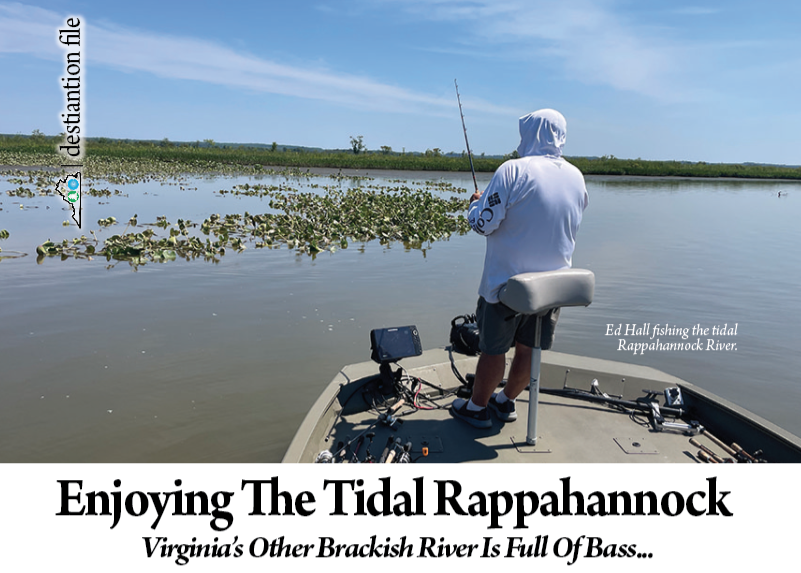
Recently I had a free day, and it coincidently was going to be one of the cooler ones in July, so I reached out to W2 Pro Team member Ed Hall, himself a well-respected and well-travelled Virginia angler and someone I have enjoyed fellowshipping with over the years. He and his wife, Stephanie fished with my crew up at Lake Moomaw one fall. He was the one that pointed me in the right direction to fish the Inner Banks. Hall is also a member of the Green Top Sporting Goods Pro Team and I see him at events throughout the year. He’s always upbeat and positive, just what makes a great, fishing ambassador and a lot of fun.
He and I arrived at the ramp on the northern side of the river at Leedstown Campground not knowing what it would be like. We were pleasantly surprised that we didn’t need to travel down any dusty, gravel roads to get to the ramp and that there was plenty of water to launch the Anna’s Marine Center Tracker Grizzly 20272 even near low tide.
“It’s gonna be a good day, Chris,” Ed told me with a grin and his characteristic belly laugh as he held the Grizzly on the dock when I went to park the truck.
We chose that ramp based on where we wanted to try fishing, a weed-filled bay about two miles away. You see for much of its length the tidal Rappahannock River is like fishing in chocolate milk – there’s a lot of sediment in it. However, when you find creeks and bays with submerged aquatic vegetation like hydrilla or other grasses the water magically clears up due to the filtering ability of the underwater vegetation.
Yes, you can catch fish in the less clear water pitching to abundant hard cover, lily pads and creek mouths but the fishing is often better in clearer water.
Hall and I had prepared by rigging up spinnerbaits and soft plastic stickbaits – what I had caught fish on before with Lee. Hall is a bit of a talent when it comes to making lures and the spinnerbaits he produced for this outing were his own creations known as Deep Ledge Custom Baits. The baits were probably 1/8-oz with a tandem bladed configuration – both turtle back style, one gold one silver. The skirt was really unique with strands that really glimmered like a baitfish in the water using a combination of chartreuse, blue glimmer and smoke. I noted a lot of small baitfish in the areas we fished successfully, and I think the blades of the spinnerbait matched the hatch.
Another lure we used was something Hall’s wife, Steph dubbed the Baby Bait Shaker. It was a tiny (probably 1/8-oz.) vibrating jig in brown (lip and skirt) with a blue crawdad trailer. You had to reel it VERY slowly to produce the steady vibration generated by the tiny blade. The flapping legs of the craw trailer made it look very much like a fleeing crawdad.
It didn’t take long to determine that the fish we were after were in the grass and around wood in that grass just inside the clear water line. When we arrived at 7:19 am the tide was still falling and wouldn’t turn around until 11:30 so we had a decent tidal window as bass on tidal rivers tend to bite best on moving water.
Ed struck first within 10 minutes when his Deep Ledge spinnerbait was engulfed by a spunky Rapp River bass halfway back to the boat on a cast to the marsh edge. For a pound-and-half bass it fought bigger than it appeared Hall’s prediction of a good day would be accurate.
The next fish we landed was a northern snakehead which rolled Ed’s spinnerbait hard on the next marsh point down we hit. He took his eye off his bait for split second and I hollered, “Ed!” when I saw the fish boil the bait.
Then, my fishing partner leaned back on the Berkley Lightning Rod he was using, and that little spinnerbait held up to the Vise-Grip like jaws of a fine, five-pound snakehead – another fairly common resident of the tidal Rappahannock River.
“Oh, man I’m loving this place!” Ed told me when I wrestled the fish into the landing net. He loves to cook and was already planning a snakehead meal.
Wherever you looked that morning in that particular area there were baitfish and water so clear you could see the hydrilla and bottom in some bare areas where fish had made beds. We just made two or three passes, catching bass each time. As the tide began to slacken, so did the action. The last two fish we caught came on the Baby Bait Shaker. Ed fooled a nice four-pounder and a three pounder that jumped on the vibrating jig masquerading as a crawdad just as it came over submerged logs.
At some point that morning I pulled up on a line of main river lily pads that had two feet of water still on them with some current and pitched a ZOOM Speed Vibe blue craw on a Perfect Jighead to the edge a few times. About the fourth time I noticed my line moving against the current and drew back the Fenwick HDS rod and Revo reel spooled with braid.
What happened next was noteworthy.
A massive snakehead estimated at over 16 pounds exploded between the pad line and the boat. It appeared it had eaten a white perch AND my crawdad, so I really didn’t know if I had it hooked. I found out just as soon as it started to swim back to the pads when my line went slack, and the crawdad came flying back at us.
“Wow! I think that was the biggest snakehead I’ve ever seen!” Ed said. He should know as he landed a 17-pounder fishing the tidal Potomac this year.
With the air temperature approaching 92, not a cloud in the sky and no breeze, I called it at 1 pm and we headed back to the ramp at Leedstown. We did check a few other areas nearby but didn’t turn any fish except where we found hydrilla that morning.
When I got back home, I emailed Virginia Department of Wildlife Resources District Biologist John Odenkirk to tell him of our morning and ask if he had any biologist take on the current state of the fishing on the tidal Rapp.
He told me via email that he and his team samples the Rapp every September but the numbers from 2025 were encouraging. “It’s really doing quite well,” he wrote.
DWR samples largemouth bass (LMB) at six sites by boat electrofishing (EF) between Fredericksburg and Port Royal as part of a recruitment/population study that began in 2003 due to complaints about poor bass fishing in the tidal Rappahannock River.
Odenkirk said LMB EF catch rate (catch per effort, or CPE) of adults in 2025 was 50.7/hr. which was above the 90% confidence interval (90% CI) for the period of record (23 years). Record adult catch occurred in 2023 when CPE was 62.3/hr. Adult CPE totals five of the past six years were the highest of the study.
LMB juvenile CPE in 2025 was 14.2/hr. which was above average (13.8/hr.) but within 90% CI. Seven of the past nine years produced CPE above average, suggesting numerous strong year classes including a record in 2023 (32/hr.).
LMB size structure remained desirable (PSD=77; RSD-P=29) and increased from 2024 (PSD=55; RSD-P=22) likely reflecting recruitment of numerous strong year classes into both quality and preferred size ranges.
Prior LMB age and growth analysis indicated rapid growth (e.g., an age-3 fish averaged 356 mm), consistent recruitment and high survival (67%).
Previous LMB cohort-based mortality analyses were comparable to total annual mortality (TAM) per above (33%): 2004 YC =37% (r2=0.82) and 2005 YC =35% (r2=0.89).
Submersed aquatic vegetation (SAV – primarily hydrilla), while not quantitatively sampled, appeared to be less abundant last year than in recent years. SAV was prevalent at seemingly record levels in the mainstem in the early 2020s.
Odenkirk told me the first northern snakehead (NSH) was discovered in the Rappahannock River in 2012, but this population was slower to expand than in the Potomac. NSH abundance (5.0/hr.) was like 2024 (4.7/hr.) and below a peak established in 2022 (10/hr.). The dome-shaped population growth curve was temporally like those observed on Potomac River tributaries with maximum abundances occurring about a decade post colonization.
NSH lengths-at-age for fish aged 1-3 in 2025 were 17.16”, 22.9”, and 25.03” TL which were significantly different from lengths-at-age in 2024 with no pattern (e.g., some ages were shorter, while others were longer, likely due to low sample sizes and high variability inherent in snakehead lengths at age). Most NSH in the Rappahannock were again longer at age than those on the Potomac, but Rappahannock fish were fall collected, while most Potomac fish were sampled in spring or early summer.
I will note, that as a lifelong Lake Anna fisherman I was a bit taken aback by all the river grime I had to wipe off the Grizzly afterward but it’s a small price to pay to enjoy such a different fishing experience that what I am most used to on my home lake.
Ed and I will probably be fishing a bit more together in the coming months and I couldn’t think of a much better fishing partner. He and I both share the explorer trait to seek out and experience new places and I like someone that says, “It’s going to be a good day” before we even make the first cast.