
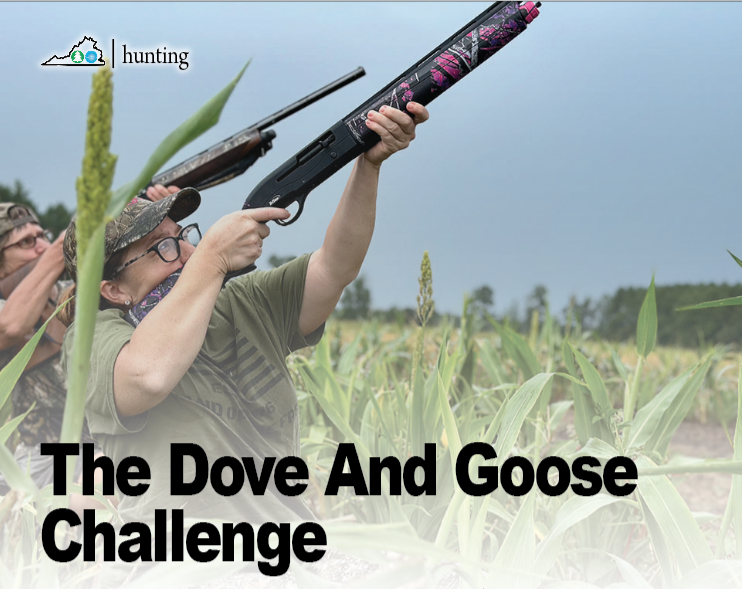
Let’s talk about realistic hunting challenges for Virginia hunters. How about dropping a dove and goose in one day? You’ll be pursuing 50-mile-per hour softballs and armored drones if you accept the challenge. Is it even possible? It can be if you know where to look, have the right equipment and move quickly from venue to venue. Here’s some advice on how to drop this early season feathered daily double.
Goose
Early goose season begins at legal shooting hours and that means sunrise. You can choose to hunt early or late for resident geese, just be sure you’ve scouted them before showing up and have some idea as to where you’re going because you often have one or two shots before they wise up.
Public lakes and private ponds are abundant in our region. Many farmers do not like the resident geese as they cause damage to crops and yards. Take some time and ask to hunt their small ponds so that you can help them reduce the problem.
Access to public lakes can also be accomplished in the rural areas by asking permission of homeowners to set up off their docks or put your jon boat in from their property and set up in front of their pier. Many lake property owners are frustrated with the damage to the manicured lawns that they try to maintain all year. Just keep in mind minimum distances you can hunt from an occupied dwelling. This often varies from county to county, so be aware of this BEFORE you set up your decoy spread.
If you can, try and buy a half dozen decoys or ask someone to borrow a little flock. Most experienced waterfowl hunters are eager to encourage and help beginners and may be willing to lend you or give you a few of their old decoys.
Decoys are not an absolute necessity because resident geese will often come repeatedly into an area where they feel safe – where they were yesterday is where they often go today. The decoys will help but you can be successful without them. Calling to resident geese is also not critical.
As far as specialized camo, don’t get too involved. Your lightweight hunting clothing will provide the necessary camouflage cover.
Beginners usually think that they need a special gun for waterfowl hunting, but this is not the case. Granted many new guns today are designed with waterfowl hunting in mind, with camouflage coverings, weather resistant coatings and specialized choke systems.
You can actually use your existing deer hunting shotgun to experience the fun of goose hunting. Waterfowl hunting does require the use of steel or non-lead shot, which if shot enough can wear down your favorite deer barrel.
Shooting geese usually requires larger shot such as BB. When you look at the expense of blended metal shot such as Hevi-Shot, it appears to be expensive, but if you compare shooting a bird one or two times to shooting three or four times, the blended metals products are cheaper and you feel more comfortable in your abilities. We also have an ethical obligation to make a quick, clean harvest. Consider this when buying your ammo and patterning your new barrel.
Be sure to check all the laws as there are three hunting zones in Virginia for goose season, each having different rules. You will also need a Virginia hunting license, state and federal waterfowl stamps and H.I.P. permit. Once you have found a farm pond or public water location, talk to an experienced goose hunter about set up locations, wind directions and calling techniques.
If you buy a good beginner goose call it will have instructions on basic calling, which is all you need to call the more relaxed resident geese, if any calling is even necessary. Use your existing camouflage clothing and any deer blind material you have to cover up you and your gear. Hunt the mornings and evenings trying your calls, watch the reaction of the geese and try to learn new things. In no time you will be off to the next challenge at noon…
Dove
Dove hunting is a favorite early season activity among area shooters. As long as you understand that not every cornfield has doves and that some overgrown fields can be loaded, you’ll at least understand just how random a good dove shoot can be.
Keep in mind, the first segment of dove season begins each day at noon. With that being said, location is critical in dove hunting, both in having a location with birds and in surveying the location for bird patterns.
The most successful dove hunts take place on managed dove fields, either public state run operations, pay to shoot hunts, or private venues. During season, check out message boards at sporting goods stores, Woods & Waters Magazine and word of mouth for good hunts. Public hunting lands take a lot of pressure from the public. Make no mistake about it, it will get crowded early as people come in several hours before shooting time to pick out the good spots and make claim. Pay hunts are usually fairly reliable and you can expect to pay anywhere from $50 to $150 a gun. Ask around to see if anyone has experience with a certain outfitter. If you live “out in the country” and know landowners and farmers who will let you hunt, that is likely the best route to go.
Given the choice to hunt a cornfield, sunflowers, or some combination of these with or without various millets, I would choose sunflowers. And each particular field will show a preferred feeding route for the birds. From the nesting areas the birds travel a predictable route to and from the field. Scout this if you have time and set up accordingly. Do not be afraid to move if you aren’t getting birds and it is ok with the host – trust me on this one – if there are only a few birds and they are showing a particular flight path you want to be able to reach them as they travel that pattern.
With regards to clothing and concealment, I can tell you that like most game, doves have great eyesight and will flare if they see movement or color contrasts they don’t like. Sure, ol’ granddad will claim he hunts ‘em in a white tee shirt and flip-flops, but I recommend colors that blend into the surroundings. Camouflage is not required, but the clothes should be earth toned at the least. I like a wide brimmed hat for sun protection.
There’s way too much yakity-yak about guns and loads and such. You got a gun bigger than a 28 gauge? Bring it. By some quality #8 shot loads, one ounce for 12 gauge, and 7/8 ounce for 20 gauges. Use modified choke for single barrels, IC and Modified for double barrels. Bring some cold drinks. A sports bucket will come in handy for keeping drinks, extra shells, and bagged birds, and giving your feet a rest.
Using dove decoys is a good idea. The rotary winged versions are effective, but tend to cause lots of low birds so be careful. Decoys for power lines and fence posts are DEADLY. And you only need three or five decoys: Place one decoy. Then 10 feet away put the other ones spaced about a foot apart. Watch the birds come from 100 yards to get in that open spot.
FYI, the ticks and chiggers can eat you alive in a dove field. Spray down liberally with Sawyers Spray before the hunt.
Well, there you have it – an early season game challenge worth attempting. Good luck!