

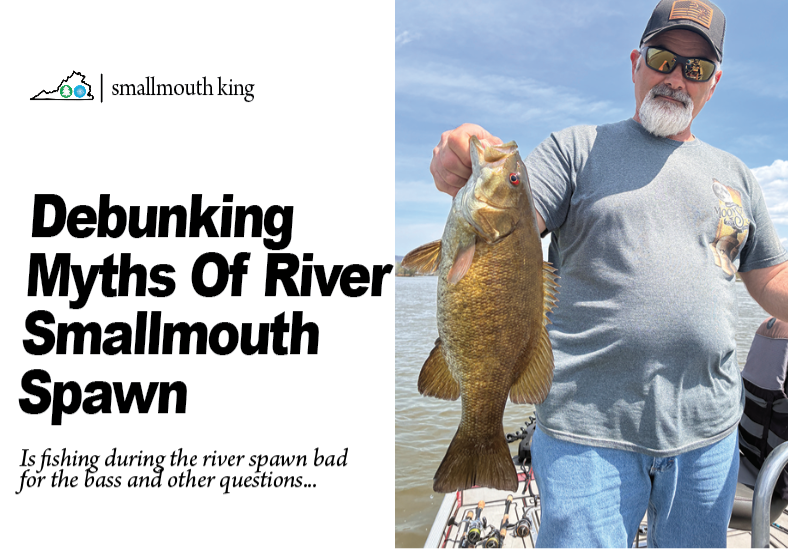
Year over year, the conversation about river smallmouth bass spawn frustrates me more than any annual fishing topic. The amount of information out there is often wrong, misguided or exaggerated. Part of this comes from where studies are done and assuming that all black bass species are similar in the how, when and where spawning occurs. A further issue identified in many studies is their focus on impoundments, typically large lakes, where the patterns of water temperature increase and the extent of daily temperature fluctuations differ considerably from a lake to a river. Add in angler bias, emotion over logic and the topic spins out of control.
If we dive into the environmental factor first and build from there, much of what really happens during the actual spawn can be explained and understood. Every study on the topic lists factors like moon phases, length of daylight and water temp. And for what it is worth, these are indeed critical no matter which body of water the spawn occurs. Better yet, all these factors are tracked to a level of absolute accuracy. Anglers can check moon phases and length of daylight months, even years in advance. However, when it comes to water temperatures, this is where most conclusions on spawn go off in left field. Water temperature is quite different between rivers and lakes and that is a key reason for misinformation.
The graph on the facing page is from a USGS Station that monitors water levels and temperatures. In this instance the river rises 10 degrees in less than a week, where in the same time frame many of the lakes in the region have seen changes of only a few degrees. Another difference with shallow rivers is that the water mixes top to bottom so there is little difference in the surface temperature and bottom temperature. Keep this in mind as water temperature is not only a factor in when fish spawn, but also how quickly eggs hatch.
Do All Bass Spawn at Once?
The simple answer is an emphatic NO! Generally, the older, more mature bass spawn first followed by another wave or two. Beyond that, different areas of the river and the tributaries will spawn at different times. This is nature’s way of ensuring their survival.
Do female smallmouth lay all her eggs at once ?
Anglers often see bass start to pair up days and perhaps a week before spawning occurs. Long before there is evidence of a bed, sightings of pairs in protected pools are often signs the spawn is close. The pairs are quite locked together, generally the female is much larger than the male. But being in pairs does not mean that the female will lay all her eggs for the one male to fertilize and protect the bed. Depending on the population and the size of the breeding area, a female bass can lay eggs in multiple nests when she starts the process. Smaller fish with lower egg counts or areas with only a couple of nests will likely result in the female depositing them in one nest.
How long does it take for the eggs to hatch?
For decades now I have read information that goes against everything I see on the water every spring. Magazine after magazine would state a gestation period of 7-10 days. But remarkably, here on the river it is generally two to three days in most cases. It took me a while and a bunch of springs lake fishing to realize the difference. As mentioned earlier, water temperature plays a key role in how fast the eggs hatch. Our shallow rivers warm up quickly and stay warm, allowing the eggs to hatch quicker than lakes where water temperatures rise more slowly.
Is it easier to catch bass during the spawn?
Well, it is certainly easier to find bass. Most anglers know that when a male is protecting the nest, he is generally not taking the lure to eat it, he’s trying to kill it or keep it from the nest. So outside of the days leading up to a wave of spawning activity, once the females lay her eggs, she is usually out of the area within hours and all that is left are the smaller guarding males. It is this man’s opinion that once the eggs are in the nest or fry is hatching, anglers should avoid these areas for four to five days. Regulations are in place to help protect the spawning fish but are rarely easy to enforce. We have to police ourselves.
Are anglers who target bedding bass hurting the resource?
This topic is like opening a can of worms. Let me say that mother nature causes far more damage to eggs and fry than anglers. Flood waters will completely decimate spawning grounds. High water and current can rob the nests YOY (young of year) far worse than anglers can by pulling males off the nest and leaving them unprotected for a period of time.
Likewise, diving birds such as cormorants and mergansers, blue herons and egrets, eagles and osprey cause more bass mortality during the spawn than anglers could ever. I have even heard arguments from fisheries managers in places like New Hampshire state openly that the presence of boats in spawning areas keeps predatory birds away from shallow breeding areas where bass are most vulnerable. Even with all that, my upbringing and the regulations of my state keep me from repeatedly targeting bedding areas. So I say leave the males protecting the nests alone for a few weeks.
Should anglers’ fish for bass during the spawn?
Yes, there are plenty of areas on lakes and rivers to find bass that are not participating in the current wave of spawning. Swift open water is just as start. When it comes to rivers, if anglers are targeting seams and current, they are not engaging spawning fish. And unlike bass who are in protected spawning areas, bass in current are actively feeding.
Personally, I find fishing during the spawn more of a challenge. I generally seek the current and open water areas where larger females are not actively spawning, and instead are actively feeding.
In conclusion, pay attention to late April, May and early June on your home waters. My grandmother’s rule of “Look but don’t touch” is a good one to follow. I check spawning areas almost daily and note how long it takes for the bass to mate, and how long the males stay on the nest. I also note when the next group comes in and repeats the process. I implore others to do the same and keep a log as to how quickly active nests on your home river are vacated.