

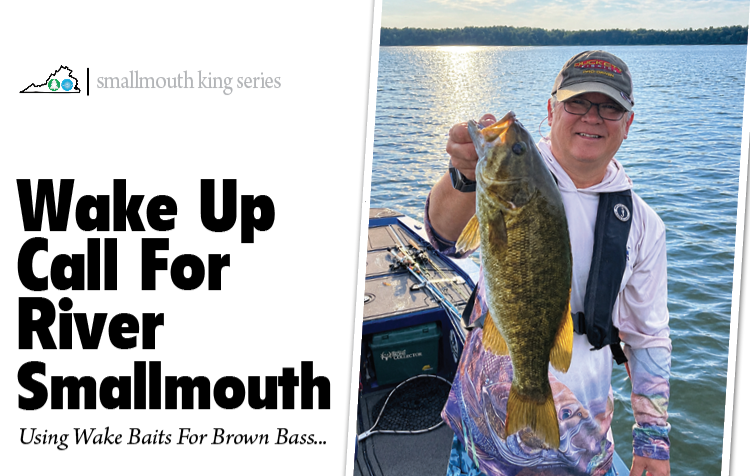
While lipped wake baits have been around for nearly three decades, they may be one of the most underutilized lures for smallmouth bass.
It could be price or availability, or it could be that they are overshadowed by other surface and subsurface lures. When it comes to shallow rivers, those who know, know and outside of their regular fishing partners, few anglers get to see just how productive these wake baits are.
Most would be surprised at just how shallow smallmouth bass will go to forage and feed. I recall idling my boat down the river and scanning across a shallow rocky flat. I set my trolling motor as high as it would go and deployed it. The Susquehanna was gin-clear and I convinced myself the area was as empty and desolate as it gets. Every rock was visible with only a few large rocks spread out here and there.
Then I saw something, a large bass nearly invisible against the river floor, cloaked in plain sight. Knowing they are there and finding a way to target them is the real secret. So if turning shallow ambush areas into explosive hook-sets sounds like fun, you have come to the right place.
Wake baits were created for moments when fish are willing to look up but do not want a loud, popping or spitting topwater. A lipped wake bait pushes a steady line of disturbance across the surface or just under it, motion that can pull bass from current seams, grass edges, laydowns, boulders, and bank cuts. In high pressured areas and shallow rivers where bass are easily spooked, these less noisy baits are a near perfect solution.
As I have shared in seminars and articles in the past, river smallmouth use current like a conveyor belt. They hold beside rocks, wood, points, grass clumps, and shoreline irregularities where fast water meets slower water, then slide out to intercept food. A wake bait excels because it stays in the strike zone at eye level, makes enough disturbance to be tracked in moving water, and can be guided naturally with the flow instead of fighting against it.
The floating nature of these baits allows anglers to stop, without concern of it sinking or snagging on the bottom. Another advantage over traditional top water is that they operate at high speeds, and there are times when this ‘escape’ attempt just triggers strikes when a slow popping or walking plug is ignored.
Lipped wake baits are a preference since the bill helps them to track and are extremely easy to use. Similar to a crankbait, only in this case running at or just under the water’s surface. This action creates a consistent bulge (or wake as the name implies) on the surface of the water.
Wake baits can be used in a wide variety of water and cover areas quickly. Most believe they imitate a baitfish profile, but if you have ever walked through shallow rocky areas in this river, crayfish will skitter quickly just under the surface trying to escape. So mimicking minnows or crayfish, it is a win for river anglers.
Jointed wake baits, with two or three segments, are an excellent option on their own or when bass are charging but not striking smaller, non-segmented wake baits. The segmented body adds an exaggerated wabble and wake during the retrieval. This action pushes more water to look like larger baitfish such as fallfish and creek chubs.
Overall a segmented wake bait will better match the size of these larger minnows. An erratic stop and go presentation really look like wounded baitfish and easy prey. Always keep in mind just how opportunistic smallmouth are.
While on the topic of how to work a wake bait, I generally suggest a slow, steady retrieval that keeps the bait bulging the surface without diving. In clear water or when current is modest, slow down until the lure barely crawls. Likewise in current (nervous water) or when wind is impacting the water’s surface, speed up enough to keep the wake visible. Around cover, add short stops or vary speed. Pause or slow down the retrieve for a second or two, then restart.
Many of our bites happen when the bait changes speed at the edge of structure, cover or current seams. Do not ignore the value of speed here, sometimes a faster retrieval is what they want. Experiment and let the bass show you what they want.
There are times when angle matters as much as speed. In many cases the strike zone is along the bank or structure the bass is using for cover. This could be a downed tree, a rocky bank, island point, grass bed or any structure that provides an ambush point. Whenever possible, cast the wake bait parallel along the target area rather than perpendicular. The longer the lure is in the strike zone, the better the chance for success.
Rivers that run super shallow in late summer can be challenging. Having lures in your box that master these conditions can make all the difference in the world. Hope that reading this was as enjoyable as writing it. I can not wait to bust mine out and see how many smallmouth we can ‘Wake-Up’ tomorrow morning.