
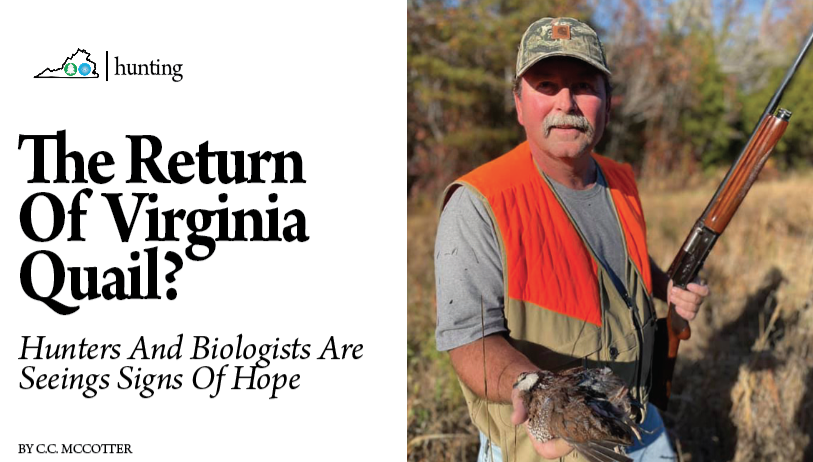
While it remains true that Virginia’s bobwhite quail population has been heavily reduced over the long term by habitat loss and forest succession, the Virginia Department of Wildlife Resources continues to focus management on early-successional habitat and private-land restoration, and there are some bright spots to note as we approaching quail hunting season.
W2 caught up with Jay Howell, DWR’s Small Game Project Manger recently to see if he could correlate what some Old Dominion hunters are noticing, that the frequency of encountering quail is increasing.
“Our spring surveys they seemed to indicate a good year, higher than last year. I’ll admit I was worried about the winter we had but the birds seemed to have come through it ok. We also had a drought but I don’t think they were negatively impacted by that. We don’t have any late summer surveys to quantitatively support this, though. I do think the remaining birds have adapted to the ways we are now managing farmland. The ones that are here are the ones that have survived.”
Now typical predictors like weather and soil moisture (very dry May and June) may not be pointing to a great 2026-27 quail hunting season, but there are areas with hardy birds. Specifically, southern and southeastern Virginia where agricultural/ grassland habitat is common, still maintains decent quail populations. Hunters are also noting many clear cut forests with five-year re-growth can also be good quail habitat and there are plenty of those, too, in central Virginia.
Not too long ago, the bobwhite quail was a common by-product of modern land use practices. However, increased industrialization, mechanization, reforestation and urban sprawl over the past 30 to 40 years have greatly impacted quail habitat and quail populations. As current land use practices continue to work against quail, landowners wishing to promote quail on their property must now consciously apply habitat management activities necessary to meet the bobwhite’s needs.
Oak dominance in hardwood stands is declining in most Virginia forest and in the south east in general. The primary reason for this decline is a dominance switch to more shade tolerant species like maple, beach, and poplar. This type of change in the species composition of hardwood forests has the potential to significantly impact wildlife populations – quail included.
Given this ongoing forestal change the following are some methods to manage land for quail habitat being used around Virginia.
Crop Tree Release
This is probably the most intense practice for hardwood management but often the most appealing is a crop tree release. A forester, wildlife professional, or the landowner selects trees that are important mast producers. Generally this is best accomplished by the landowner because he is more familiar with his property and which trees produce mast on a consistent basis. Competing trees and/or non-mast producing trees that are in close proximity to the selected trees are removed. Only trees that have branches touching the branches of the mast producers need to be removed. This “releases” the mast producing tree from competition and enables it to grow and produce more mast. This type of cut is best accomplished on a small scale either by the landowner himself or a small firewood cut or similar operation.
Timber Stand Improvement Thinning
Similar to the crop tree release, a timber stand improvement (TSI) is used to reduce competition in a hardwood stand and release selected trees to grow larger and/or produce mast. The primary difference between the two cuts is that a TSI is generally on a larger commercial scale with the objective of producing trees with a higher economic value. Timber stand improvement thinning can be a great value to wildlife if done correctly.
When planning this type of cut the landowner may want to consider laying out logging roads and skid trails prior to the cut to prevent damage to trees that are to remain and/or to act as fire breaks for future management practices.
Clear-Cutting
A clear cut, or cut-over as they are sometimes called, can be one of the most beneficial timber management practices for wildlife especially deer, turkey and quail. The value of a clear cut to wildlife is that it provides cover and forage in a fashion that is usable year around. A mature stand of hardwoods produces forage in the fall when acorns and other mast are available. Cover is not readily available in a mature stand of trees except in areas where trees have fallen or in dens. Within a year after a clear cut, early succession species begin to dominate the site and a variety of food and cover is available during most of the year. This type of early successional habitat is generally available in a clear cut for eight to ten years.
The size and shape of a clear cut depends on a variety of factors including topography, economics, and wildlife. In general clear cuts should be irregular in shape, bordered on one or two sides by mature timber, and practically sized (10-30 acres).
Creating an irregular border and surrounding the clear cut with different habitat types (i.e. mature timber, previous years cuts, agriculture) increases the amount of edge that wildlife prefer.
In larger clear cuts landowners should consider leaving an island of mature trees (1/2 acre or so in size) in the interior of the clear cut to provide mast, structure and increase edge habitat.
Other Considerations
Prescribed burning in managed hardwoods can be extremely beneficial for wildlife for several reasons. First, when burning is accomplished in a thinned oak stand where adequate sunlight reaches the forest floor herbaceous vegetation increases by as much as six times after a burn. In clear cuts, prescribed burning sets back regeneration, replenishes nutrients in the ground and encourages forbs and other useful herbaceous vegetation. Finally, as discussed above, burning can help to shift the overall structure of regeneration to favor species of oak.
Regardless of the forest management practice utilized, logging roads, trails and decks can be managed to enhance wildlife habitat. Decks and roads can be planted with a wildlife friendly seed mixture like 8–10 lbs. of common ragweed and 1–2 lbs. of partridge pea per acre to provide forage and brood rearing habitat as well as soil stabilization to minimize erosion. After a hardwood thinning operation, a landowner may want to consider expanding portions of skid trails and roads to create areas where sunlight reaches the ground and encourage understory vegetation.
Managing Pines for Quail
Cutover timberland has recently become the backbone of quail habitat, and offers an opportunity for further enhancing quail habitat on your farm. While areas managed for hardwood production are generally only prime quail habitat for the first few years following harvest, pine stands can be managed for quail throughout much of their lifetime.
Buffer Strips
The same grassy and shrubby vegetation used by quail managers for nest, brood, or winter cover can be used to develop riparian buffer strips. Combinations of deep rooted bunch grasses, shrubs, and trees make riparian buffer strips effective for reducing sediment and nutrients, and provide good quail habitat.
In general, from a quail management perspective riparian buffer strips should be a minimum of 25′ feet wide. Wider widths approaching 50′ are desirable and only enhance habitat value. The strip should provide clumped bunch grasses, such as switch grass or big bluestem, with shrubby vegetation such as indigo bush, wild plum, dogwood, elderberry, viburnum or any other fruit-producing shrub that can tolerate occasional high water. Shrubs are planted in rows closest to the water where their root systems and woody structure can help stabilize the erosive forces of water and the grasses are planted adjacent to the shrubs.