
BY WALTER CLAXTON
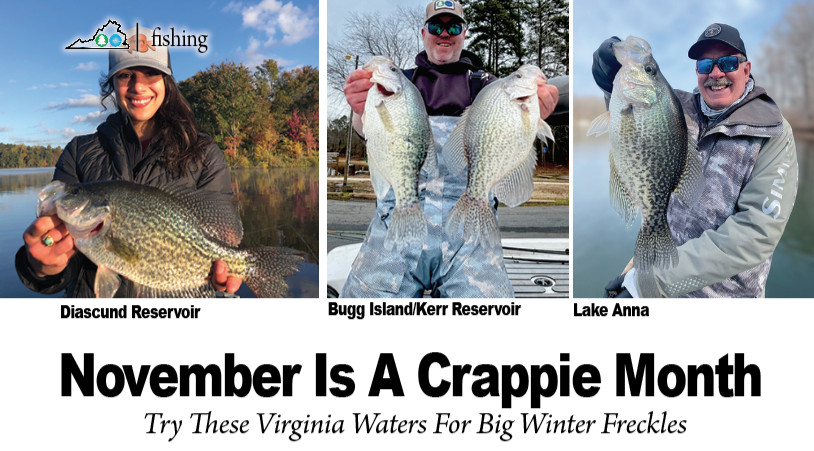
All over Virginia serious freckle anglers are gearing up for slab season, that early winter peak of activity where some of the biggest crappie of the year feed heavily in preparation for winter, that climaxes in late November and early December. Gathered here are some of the area’s top crappie fishing experts offering tips on fishing their home waters.
Lake Anna
Guide C.C. McCotter has been fishing Lake Anna for 40+ years and carrying clients with him for 33. He and his anglers have caught hundreds of citation crappie from the 13,000-acre, mostly clear, 17-mile long lake in central Virginia. He says November and December are two of his favorite months of the year to fish for freckles at the lake.
“I’ve had early winter days where one angler caught three citation crappie over two pounds or 15 inches. It’s a good time to fish because the saddlebags are gathered up, crowding structure and hungry,” he told W2.
Water temperatures on Anna will vary from 45-55 on the main lake and nearly 72 in the Waste Head Treatment Facility’s Cooling Ponds. All this adds up to depth finders reading dozens of fish on structure like rocks, stumpy ledges, bridges and brush piles.
McCotter will check waypoints with is Humminbird Helix 10 units using Side Imaging and then drop his Minn Kota Ulterra and switch on the MEGA Live forward facing sonar to further pinpoint fish position and reaction to his offerings.
The Lake Anna guide will use two-inch Baby Shad soft plastic baits on a 1/16-oz. jighead with a wire keeper. Colors are either shad imitating hues or chartreuse. If the crappie are “right” the jigs never come in contact with the structure they are on. McCotter free falls the lure to the fish and then barely reels it in, maintaining a depth just above the fish and watching the Humminbird, his line or just feeling the bite. He says 85% of the time the fish hit the bait on the fall. The other 15% they will hit soon after he starts reeling.
At some point in December, when the water drops to 45 and below, he may use slip bobbers tipped with minnows or fish the jig or a small spoon right on the bottom but he’ll fish the jig as long as possible.
Buggs Island/Kerr Reservoir
Josh Morris is the tournament director of the Richmond Crappie Club Trail. He also fishes the Virginia/North Carolina Crappie Trail held by Bobcat’s Bait & Tackle on Buggs Island Lake/Kerr Reservoir.
On Buggs, “Low water would be the challenge this year,” noted Morris. “I’ve never fished it more than four feet low.”
Generally though, Morris says he targets big fish in the creeks in early winter, specifically the mouths of creeks.
“These fish are roaming in the dirty water, while the mid lake fish in clearer water tend to school up on brush. The nice thing is that once you find the fish, they don’t move much like in the spring.”
Lake Chesdin
Morris also has some knowledge of Lake Chesdin, the 3,100-acre impoundment created in 1968 with the damming of the Appomattox River.
“This lake is so loaded with little crappie it looks like acorns on the bottom on your depth finder. If you see a fish up off the bottom, it’s ususally a good one.“
The mid lake main river channel is where Morris findss the best fish suspended.
Tidal Potomac River
USGC Captain Mike Sielicki lives on the banks of the tidal Potomac River. When he’s not guiding for snakehead, he’s putting anglers on brackish water crappie.
He likes fishing with plastic or hair jigs in five to 15’ of water for tidal Potmac freckles now.
“Fish the edge of the flats and channels in front of a tree. You’ll find slabs there this time ofyear.”
His favorite tidal water lures include Beetle Spins, Road Runner type baits and Slider style jigs rigged weedless. His baits are 1/32 to 1/8 sizes.
On occassion, he’ll even pitch jigs under certain docks on the tidal creeks he fishes.
Little Creek And Diascund Reservoirs
Morris says he’s only fished Little Creek Reservoir a handful of times but he’s fished Diascund Reservoir more. Both reservoirs are near Toano, just west of Williamsburg.
“I’ve probably caught just as many two-pound crappie from Diascund as I have fishing Buggs Island, and I’ve fished Buggs probably three times as often.”
For wintertime crappie fishing Morris really likes fishing some of the bigger fisheries in Virginia and noted why.
“A lot of the smaller lakes can be fruitful in the winter as well, but I typically avoid shallower lakes (lakes and areas predominantly 15’ or less). I’ll wait until late February or March and switch my focus to those places when they begin warming up quicker. It seems like in the shallow lakes in the wintertime those fish will hug the bottom and become significantly less active,” Morris said, “On the bigger bodies of water – like Buggs Island or Lake Anna, those fish have plenty of water and a lot of those fish that seem to hide eight months out of the year finally come out and are much easier to find and target. The bite can sometimes get a bit frustrating when the water temp drops into the 30s but I’ve had some phenomenal days in the winter when the water temp is in the 40s and 50s.”
When fishing for freckles, Morris says he typically uses moving baits in the fall and spring but in “peak” winter he does a lot of deadsticking, especially with hair jigs.
“My favorite hair jig is a white and blue jig made by Joe Maione with NicTaylors Jigs. The colder and clearer the water, the smaller the jig.
“I really enjoying traveling to Lake Anna in the winter because it seems to be the best time to avoid the boat traffic and the crappie fishing can be spectacular. I’ve had several days where I’ll run 10 miles and fish for eight hours and not see another person crappie fishing. While the bass and striper fishing are good there in the winter, those that aren’t crappie fishing are missing out.”
Morris also added he tends to cycle with the weather among his favorite winter crappie fisheries.
“To me it also seems like as the season changes from October through March different fisheries will have their time to shine. For me, it’s paying attention to the water temps. I like fishing places in the fall that cool down first and in the spring the places that start to warm up first. Probably my favorite temperature range is around 50-60 degrees so that’s what I’m looking for.”
As far as what Morris’ advice for other anglers is for winter crappie fishing, he notes that while sometimes you’ll find large schools of crappie, typically he finds areas with scattered fish.
“I try to focus on areas that have the highest concentrations of fish. Spider rigging is a great technique, especially for those without forward facing sonar or for folks new at live scoping. Be sure to keep your bait above the fish. Structure fishermen typically struggle in the wintertime because most fish pull off of the docks and bridges (aside from a few year-round community holes), but get electronics and learn how to use them and even though the water’s cold, a lot of times the bite is hot.”