
BY JUSTIN FOLKS, VDWR
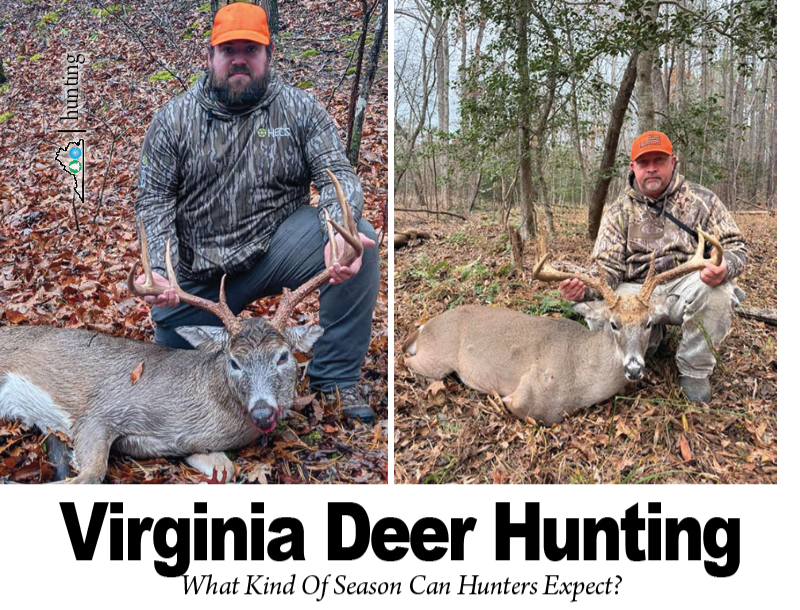
Welcome to the 2026 Virginia Deer Report, where we dive deeper into this past deer hunting season. I’ll talk about the 2025-26 deer harvest summary, the current deer population status, disease updates, and the importance of doe harvest. There’s a lot to cover, so let’s get to it with a look at the deer harvest summary from last season.
During the 2025-2026 deer seasons, including the early September antlerless seasons (firearms and urban archery), hunters reported harvesting 227,302 deer, up approximately 10% from last year’s total of 205,759 over the same timeframe, and up 14% from the previous 10-year average of 198,666. This year’s total included 108,163 antlered bucks, 14,631 button bucks, 973 shed bucks, and 103,535 does (45.5%). Archers took 32,730 deer, while 51,472 were taken with muzzleloaders and 143,100 with firearms. 2,636 deer were reported harvested during Youth and Apprentice Weekend. In counties where it is legal to hunt deer with dogs, dogs were used to take 50% of the deer killed during firearms season and accounted for 35% of the annual kill there. The late antlerless seasons added about 2,000 more antlerless deer to the total harvest. Out of 177,541 deer licenses sold, 99,351 deer license holders reported harvesting a deer, yielding a 56% success rate (although it’s likely higher because some license holders may have only hunted turkeys).
A significant number of deer hunting regulations were changed this past season (most changes occurred in firearms season west of the Blue Ridge [WBR]) in efforts to increase opportunity and increase doe harvest to meet population objectives.
Compare the deer kill on private lands during the traditional two-week firearms season and the following two weeks of late muzzleloader (averaged over the previous four years) along with the deer kill during the new four-week firearms season on private lands WBR and the buck kill went up just eight percent while doe kill increased 22 percent! It’s important to note that, in addition to increasing the length of rifle season, either-sex days increased substantially in many counties WBR during the last regulations cycle as well.
While these regulations likely contributed to the increased deer harvest, it’s not the whole story. The daily deer kill was ahead of last year’s pace from opening day of archery onward. It’s unclear what caused the increase throughout all seasons, especially considering the abundant mast (acorn) crop experienced across much of the state. Typically, when mast is abundant, deer kill goes down because deer don’t have to move far to find food.
I was also curious which counties experienced the biggest differences between this past season and the year before. Below are the top 10 counties that saw the biggest changes in total deer kill, total buck kill and percent female. Keep in mind that this is only a snapshot comparison between 2024 and 2025.
We asked a new question during harvest reporting about outside spread of main beams to estimate the percentage of the buck kill that were yearlings, but a technological issue prevented getting that data from all bucks reported (some received the question and some did not). As such, no estimate of yearling bucks was made this year, but will be reported moving forward (update your GoOutdoors app!).
Ever wonder how many deer each deer hunter takes? See below! These figures are pretty consistent with most other whitetail states, although our average number of deer taken per hunter is a little higher, at 2.09 deer per successful hunter in 2025, whereas most other states are slightly under two deer per hunter. These figures likely change when you throw in license-exempt hunters, but we currently aren’t able to include license exempt hunters because they don’t have a unique identifier (like the customer ID number).
While not a perfect measure, tracking the percentage number of bucks reported with eight or more points suggests an older buck age structure and increasing level of selectivity by hunters over time. VDWR did not maintain records of the number of antler points until 2004, when the electronic reporting option was first made available. VDWR went to full electronic reporting in 2021.
It’s no secret that the prospect of a big buck is what gets most of us in a deer stand each fall. It’s also no secret that overabundant deer have negative effects on forests, farmlands, front yards, and Fords (I like alliteration). We, as deer hunters, need to look beyond “grip-and-grins” and taxidermy bills, and think more about the big picture of deer management.
It’s hard to grow new oaks to replace the dead and dying ones in our forests (we all know how important acorns are to deer and other wildlife). No one likes kill permits (including most farmers I’ve talked to), but they are a necessary evil in a growing number of situations. Deer are overwhelming suburban and urban neighborhoods—I see far more deer each year in town than I do in my old hunting grounds. While I don’t drive a Ford, I can say that driving most evenings about anywhere in the state is a high stakes game of “dodge the deer” (my wife’s van lost this game this past winter). Virginia has been one of the top 10 U.S. states for deer-vehicle collisions in recent years.
All methods we use to monitor deer population trends indicate an ever-growing deer population on private lands, and the “eyeball test” supports that. We’ve thrown just about just about every regulation we can at private lands in several counties, including Earn-a-Buck and extended antlerless seasons, but deer abundance still isn’t at desired levels in many areas.
Those levels were determined by a diverse stakeholder group representing a broad range of interests related to deer—not just farmers and insurance agents.
It’s a much different story on public lands, especially west of the Blue Ridge (WBR). Public lands WBR are predominantly mountainous areas with poor soils, poor habitat, and much lower productivity than the private lands in the valleys. The difference is so striking that we separate our regulations accordingly, trying to address the specific deer population needs on each land type.
Contrary to what some believe, we don’t like private landowners more than public land hunters—we’re simply trying to reduce deer abundance where it needs to be reduced, and grow or stabilize deer numbers on many public lands through much more conservative seasons. We are actively pursuing ways to facilitate getting more hunters on private lands where deer herds need to be reduced, but that is a long row to hoe.
In addition to alleviating damage to forests, crops, residential plants, and vehicles, reducing deer abundance helps improve the condition of the remaining deer in the herd, including those bucks most of us are after. Lower deer densities mean increased forage and nutrition for each deer in the herd (you generally can’t have more deer AND bigger deer). Bucks are able to enter the rut in better condition and rebound from the rut more easily, giving them the ability to put more resources into antler growth. Does are in better condition and can produce bigger and healthier buck fawns, giving them a head start towards reaching maturity and maximizing antler growth.
Having a more balanced doe-to-buck ratio helps ensure does are bred during their first estrus cycle, which shortens the length of the rut, reduces stress on bucks, and leads to a shorter period of fawning. A more condensed “fawning season” makes it more difficult for predators to prey upon them (i.e., there’s so many fawns hitting the ground at the same time that predators can’t possibly eat them all—this is sometimes referred to as “predator swamping”).
Fewer deer hunters make it harder to keep deer numbers in check, and more and more places are becoming refuges for deer. If hunters fail to adequately manage deer herds, more deer will be taken under kill permits or killed by vehicles, CWD will likely spread more quickly, and hunting as a recreation will suffer.
We ask that Virginia’s private land hunters take more does in counties with deer populations above objective and to recruit new hunters to help.
Recreational hunting has historically been the most cost-effective management tool for deer (and an enjoyable one at that), but if we, as hunters, don’t do our part in meeting population objectives, the future could look a lot different.
Tidewater Forecast
The deer harvest in Tidewater has been fairly stable at between 40,000 and 50,000 deer and most counties are meeting current population objectives; however, the growing human population is creating significant management challenges. Last year, we implemented Earn-a-Buck (EAB) in Chesterfield County and the early and late antlerless-only firearms seasons in Hanover, Henrico, and James City counties to help boost female harvest. Chesterfield saw a bump in percent females harvested (6 percentage points) and there were 119 antlerless deer taken during the antlerless firearms seasons in Hanover, but only 38 and 22 antlerless deer were taken in Henrico and James City counties, respectively, during those special antlerless seasons. We’ll need more does taken in these rapidly urbanizing counties to help minimize conflicts with deer. This is the reality we face in Tidewater and other urban areas across the state.
Most counties in Tidewater are meeting their current population objective as laid out in the current Deer Management Plan, but these objectives may change with the new Deer Plan, which is being revised over the next year or so.
Southern Piedmont Forecast
If there is not a big HD event in this area in fall 2026, deer herds over most of this region should be relatively stable. The Southern Piedmont has had the highest deer harvest across all regions since 2020, with Bedford County having the highest total statewide at almost 9,000 deer harvested last season. As shown in Figure 3, over half of the deer herds in the Southern Piedmont are at their desired deer population level, but there’s work to be done in Bedford, Campbell, Chesterfield, Franklin, Henry, Nottoway, Pittsylvania, and Prince George counties.
Northern Piedmont Forecast
Over most of the Northern Piedmont, DWR continues to try reducing the deer population (see Figure 3), especially in Northern Virginia (NOVA)—Arlington, Fairfax, Loudoun, and Prince William counties—and in CWD DMA2. For the most part, the ultra-liberal NOVA deer seasons have been successful in reducing deer herds in Loudoun and Prince William counties, but not quite to the desired levels. Last year’s HD outbreak added some mortality, but likely not significant enough to make a big difference.
Stable to declining deer herds are expected and desired moving forward. Continued very high human population growth rates and deer-vehicle collisions remain important deer management issues in the Northern Piedmont (like Tidewater), and CWD is an ever-increasing problem here as well.
Northern Mountains Forecast
CWD continues to be a big issue in the Northern Mountains. On private lands in every county in the Shenandoah Valley, DWR is trying to reduce deer herds. Conversely, in the three Allegheny Highland counties (Alleghany, Bath, and Highland), DWR is trying to maintain moderate to high population levels (orange, Figure 3). Approximately two decades ago, all three of these counties exhibited a significant decline in deer populations. Since that time, regulations have been made more conservative and deer populations have stabilized and/or increased. Higher deer populations are desired and tolerated in the Allegheny Highlands because there are fewer people and not a lot of deer-human conflicts.
The severe ice storm that Virginia experienced this past winter was challenging for deer and other wildlife in this region. While we didn’t receive any reports of large die-offs in this area, I’m sure several deer starved or met their demise in other ways because of the ice (e.g., breaking legs, easy pickings for predators, etc.). Fortunately for deer in this area, the acorn crop was quite abundant, so most deer should have had plenty of fat reserves to rely on. It’s a rough life for deer up in the mountains where the habitat is poor and the winters can be harsh in some years, which is why hunting regulations remain conservative in many mountainous counties. Despite the ice up high, I would still expect deer numbers in the northern mountains to be relatively stable, and field staff reports support that.
A potential confounding variable in all of this could be the significant drought the entire state has been experiencing. As mentioned earlier, HD activity usually increases in drought years; on top of that, HD tends to be more lethal to deer in western Virginia where HD occurs less frequently. I wouldn’t be surprised if we see increased HD activity in our mountainous counties this summer/fall.
Southern Mountains Forecast
The Southern Mountains are best described by three different deer management approaches. In nearly all the counties in the New River Valley area, DWR is trying to reduce deer populations. Farther southwest, DWR is trying to maintain current/stable deer populations, and lastly, in Buchanan and Lee counties, DWR is still trying to increase deer populations. These efforts have been and continue to be successful, and we added some either-sex harvest opportunity in far Southwest Virginia last year.
Feedback from hunters and our staff there suggests a growing deer population and a need for increased doe harvest in some areas. We will evaluate closely during our next regulations amendment process that begins this fall. I expect ice impacts in the Southern Mountains to be similar to those in the Northern Mountains—deer at high elevations may have struggled somewhat, while those in the valleys did okay. As with the Northern Mountains, we could see some increased HD activity due to the ongoing drought.